Who made the most money in 2017? The per capita disposable income in Beijing and Shanghai approaches 60,000 yuan.
Beijing, Feb. 24 (Reporter Li Jinlei) The National Bureau of Statistics recently announced the per capita disposable income of residents in 31 provinces in 2017. The data shows that the per capita disposable income of 10 provinces exceeds the national level. In 2017, the per capita disposable income of residents in Shanghai and Beijing approached the 60,000 yuan mark, and Shanghai ranked first in the country with 58,987.96 yuan.
Renminbi. Zhongxin. com reporter Li Jinlei
The per capita disposable income of 10 provinces exceeds the national level.
According to the data of the National Bureau of Statistics, the per capita disposable income of residents in 2017 was 25,974 yuan, a nominal increase of 9.0% over the previous year; After deducting the price factor, it actually increased by 7.3%.
Per capita disposable income refers to the sum of residents’ final consumption expenditure and savings, that is, residents’ disposable income, including both cash income and physical income. According to the source of income, disposable income includes wage income, net operating income, net property income and net transfer income.
The reporter from Zhongxin.com found that the per capita disposable income of residents in Shanghai, Beijing, Zhejiang, Tianjin, Jiangsu, Guangdong, Fujian, Liaoning, Shandong and Inner Mongolia in 2017 exceeded the national average.
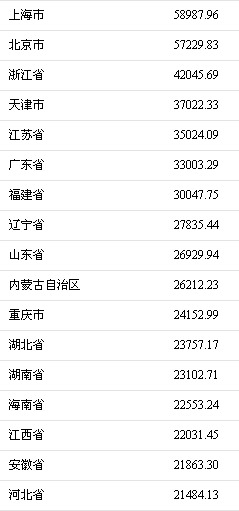
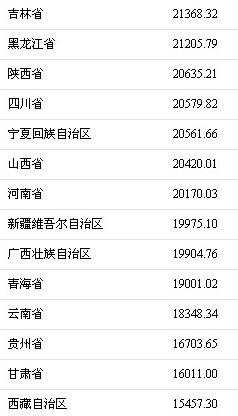
Per capita disposable income of local residents in 2017. Source: Website of National Bureau of Statistics
The per capita disposable income in Beijing and Shanghai approaches the 60,000 yuan mark.
Among the 31 provinces, autonomous regions and municipalities, Shanghai, Beijing and Zhejiang ranked the top three in per capita disposable income in 2017. Among them, the per capita disposable income of Shanghai and Beijing residents reached 58,987.96 yuan and 57,229.83 yuan respectively, approaching the 60,000 yuan mark.
Shanghai and Beijing are the only areas in the country where the per capita disposable income of residents is in the "50,000 yuan club" in 2017; The per capita disposable income of Zhejiang residents reached 42,045.69 yuan, which is the only member of the "40,000 yuan club".
The income level is high and the consumption level is also high. According to the National Bureau of Statistics, the per capita consumption expenditure of Shanghai residents in 2017 was 39,791.85 yuan, and that of Beijing was 37,425.34 yuan, ranking the top two in the country.

Residents are shopping in the supermarket. Zhongxin. com reporter Li Jinlei
The income growth rate of residents in many places outperforms the GDP growth rate.
From a national perspective, the income growth of residents in 2017 was faster than the economic growth. The data shows that in 2017, the per capita disposable income of the national residents actually increased by 7.3% over the previous year, and the actual growth rate was 0.4 and 1.0 percentage points faster than GDP and per capita GDP respectively.
At the local level, the income growth rate of residents in many places in 2017 outperformed the local GDP growth rate. For example, the per capita disposable income of Beijing residents actually increased by 6.9% in 2017, which was 0.2 percentage points higher than the GDP growth rate in the same period. In 2017, the per capita disposable income of Jiangsu residents actually increased by 7.4%, which was 0.2 percentage points higher than the GDP growth rate.
Su Hainan, vice president of china association for labour studies, told the reporter of Zhongxin.com that the growth rate of residents’ income outperformed the GDP growth rate, firstly because of the steady economic growth, the improvement of enterprise benefits and the foundation of residents’ income growth. At the same time, efforts have been made to keep residents’ income growth in step with economic growth, and a series of policies to increase residents’ income and deepen the reform of the income distribution system have also played a positive role in promoting. (End)