The most familiar stranger in the three countries: Zhou Yu in history, how did he imagine Jiangdong Diye?
Original Zhou Yu’s national human history
This article is about 5800 words.
Reading takes 16 minutes.
On April 4th (May 5th, 2000) in the fifth year of Jian ‘an, Sun Ce, the 26-year-old master of Jiangdong, was assassinated and fell into the ascendant. Before he died, Sun Ce explained to his younger brother Sun Quan that "we should appoint talents and do our best to protect Jiangdong, and I am not as good as Qing", which set a national policy for Jiangdong.
In the novel Romance of the Three Kingdoms, Sun Ce also had a famous last word: "Ask Zhang Zhao if you don’t decide on internal affairs, and ask Zhou Yu if you don’t decide on foreign affairs." Although this statement is not seen in the official history, it is summed up in place.
Non-mainstream among aristocratic children
In the late Han Dynasty, Zhou Yu was probably the most familiar stranger to the public. For hundreds of years, he couldn’t get rid of the shadow of Zhu Gekongming in the romance, and "Zhou Yu with Three Qi" even became a household allusion. Although this can be attributed to the artistic treatment of the novelist with Shu Han as the protagonist, Zhou Yu was selected as Zhuge Liang’s opponent in The Romance of the Three Kingdoms, especially after Chibi, and the two men fought many times on Jingzhou, which was not entirely based on their brains. The prototype of the story was based on Zhou Yu’s desire to achieve the emperor’s career in Jiangdong in the official history.
From Sun Ce’s establishment to the return of the Three Kingdoms to Jin, the Dongwu regime lasted for 80 years, Sun Shi was in the tiger’s position, and the stars in Jiangdong shone. Zhou Yu was more like that dazzling meteor. Although it was only a moment, it surprised the sky at the end of the Eastern Han Dynasty. Zhou Yu, whose name is Gong Jin, was born in the Zhou family of Lujiang, and his father Zhou Yi served as the Luoyang Order of the imperial court.
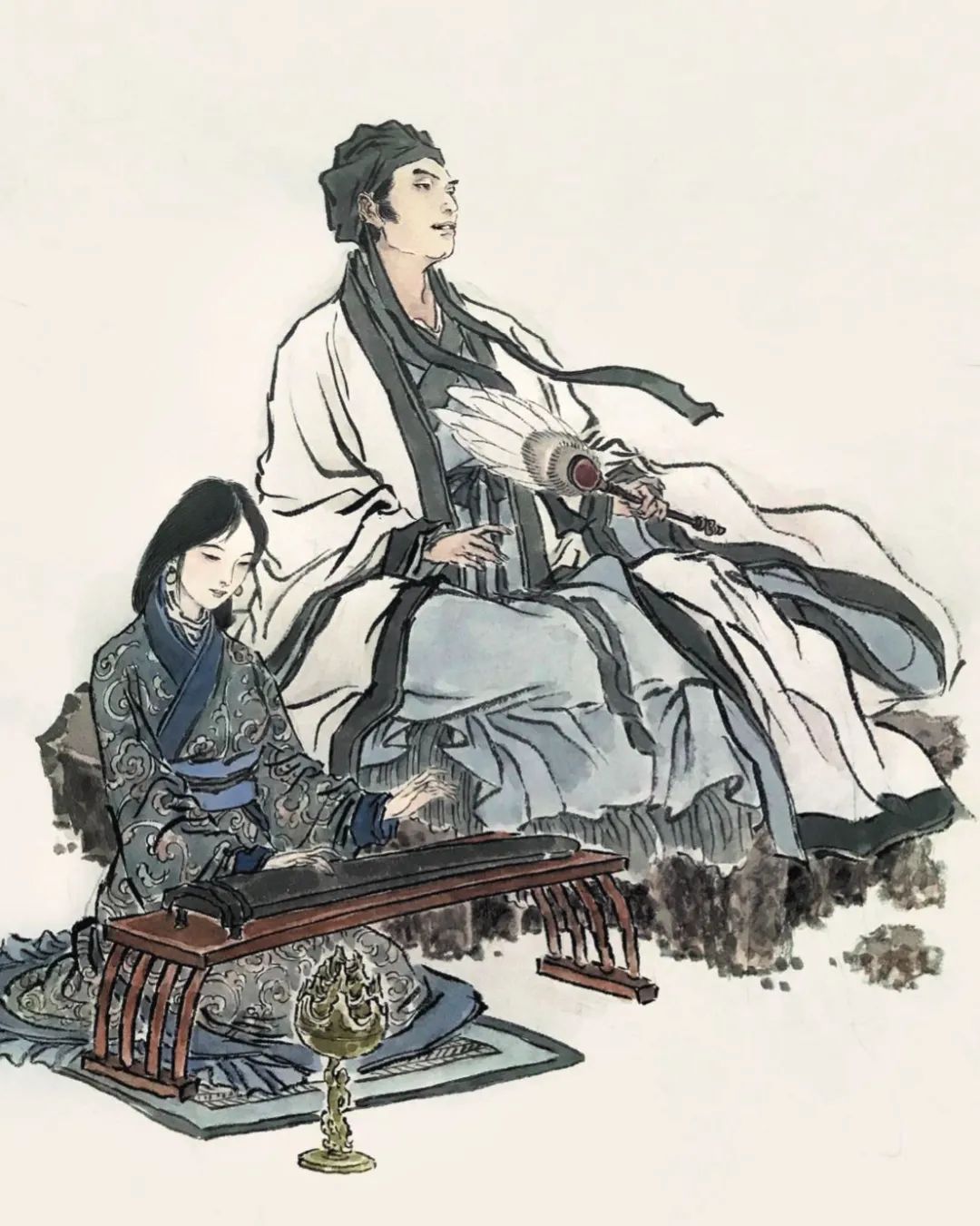
Portrait of Zhou Yu and Xiao Qiao, Modern, Li Yunzhong, Chinese painting. In the painting, Zhou Yu’s feather fan is a black silk scarf, and the woman who plays the piano beside her is Zhou Yu’s wife Xiao Qiao. Zhou Yu was proficient in music when he was young, but whenever there were mistakes in music, even after three rounds of drinking, Zhou Yu could accurately hear and correct them, so there was a saying: "There is something wrong with the music, Zhou Lang cares."
Zhou Yu’s greatness lies in that he came from an official family, but chose to study the art of war. It is rare for a noble family like Zhou Yu to choose to study the art of war, which should also be the main reason why he and Sun Ce can play together and feel like brothers. Zhou Yu and Sun Ce hit it off very well, and even invited Sun Ce’s family to live in their own compound. The two of them "ascended the throne to meet their mother" and were close. The friendship between Yu and Ce is not a false face, but also transcends identity and breaks secular conventions to a certain extent. Zhou Yu’s weak crown coincided with Sun Ce’s career crossing the river, and he led Danyang’s soldiers to help his bosom friends without hesitation. At the age of 24, Zhou Yu refused Yuan Shu’s solicitation, and went to Jiangdong to come to Sun Ce’s side to expand the territory with him.
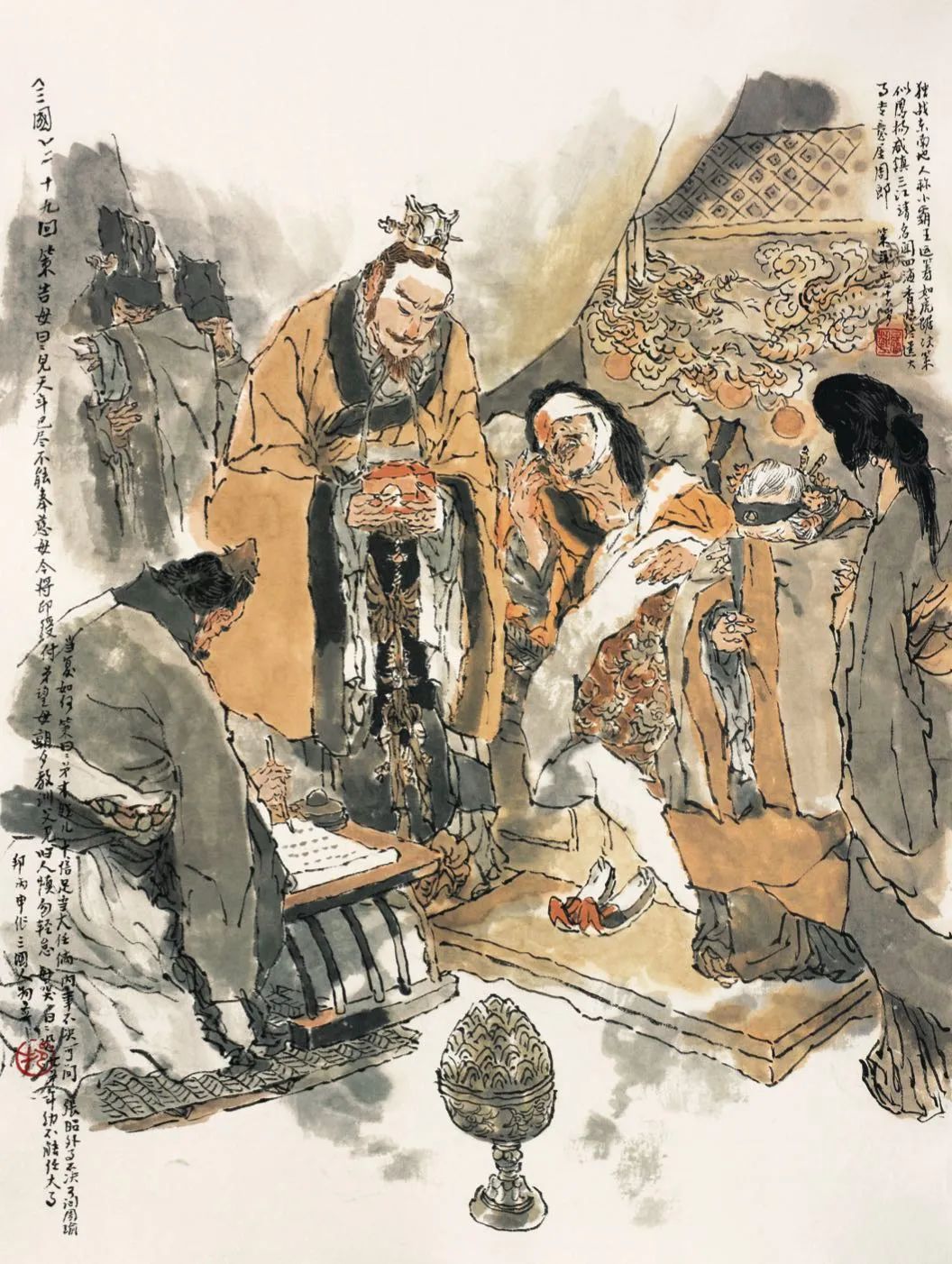
Dai Dunbang Illustrates the Romance of the Three Kingdoms, Sun Ce Entrusts an orphan, modern, Dai Dunbang, traditional Chinese painting. The story comes from the twenty-ninth chapter of Romance of the Three Kingdoms: "The bully is furious in Kyrgyzstan, and the blue-eyed son is sitting in Jiangdong". After Sun Ce’s death, Jiangdong Group was mainly presided over by Zhang Zhao and Zhou Yu.
Sun Ce lived in the world all his life, but he was stabbed to death when his hegemony was booming. When his younger brother Sun Quan was in the upper position, his prestige was not established, and there was once a crisis of trust within Jiangdong Group. On the one hand, members of the imperial clan conspired to seize the throne, and an incident broke out in which Sun Jing, the eldest son of Sun Jian, tried to stand on his own feet. On the other hand, it is the rebellion of local forces that have joined, such as the rebellion of Li Shu, the satrap of Lujiang, which has a profound impact. These two things happened in the fifth year of Jian ‘an (200), that is, when Sun Cexin died. The former was persuaded by Yu Fan, and the latter used force to conquer, which finally calmed the undercurrent, but it also exposed the undercurrent and crisis of the regime. In this case, Zhou Yu, Zhang Zhao and other important officials play a crucial role in the stability of the regime.
When the assassination occurred in Jian ‘an five years, Zhou Yu was not in Wujun. Until the news of Sun Ce’s death came out, Zhou Yucai led his troops to rush back to mourn. Since then, he has served as the guardian army, assisted Sun Quan with Zhang Zhao, a long history, and took charge of Jiangdong politics. During the eight years from the assassination of Sun Ce in the fifth year of Jian ‘an (200) to Battle of Red Cliffs in the thirteenth year of Jian ‘an (208), Zhou Yu’s greatest influence was tantamount to promoting the ideological transformation of Jiangdong Group and drawing a blueprint for Jiangdong Group.
Simply combing the transformation of Jiangdong’s national policy, Sun Ce visited Hong Zhang, a famous man, when he crossed the river to establish his career. At that time, Sun Ce’s goal was only to be a foreign vassal of the imperial court, but Hong Zhang told Sun Ce that you should "help the Han Dynasty".
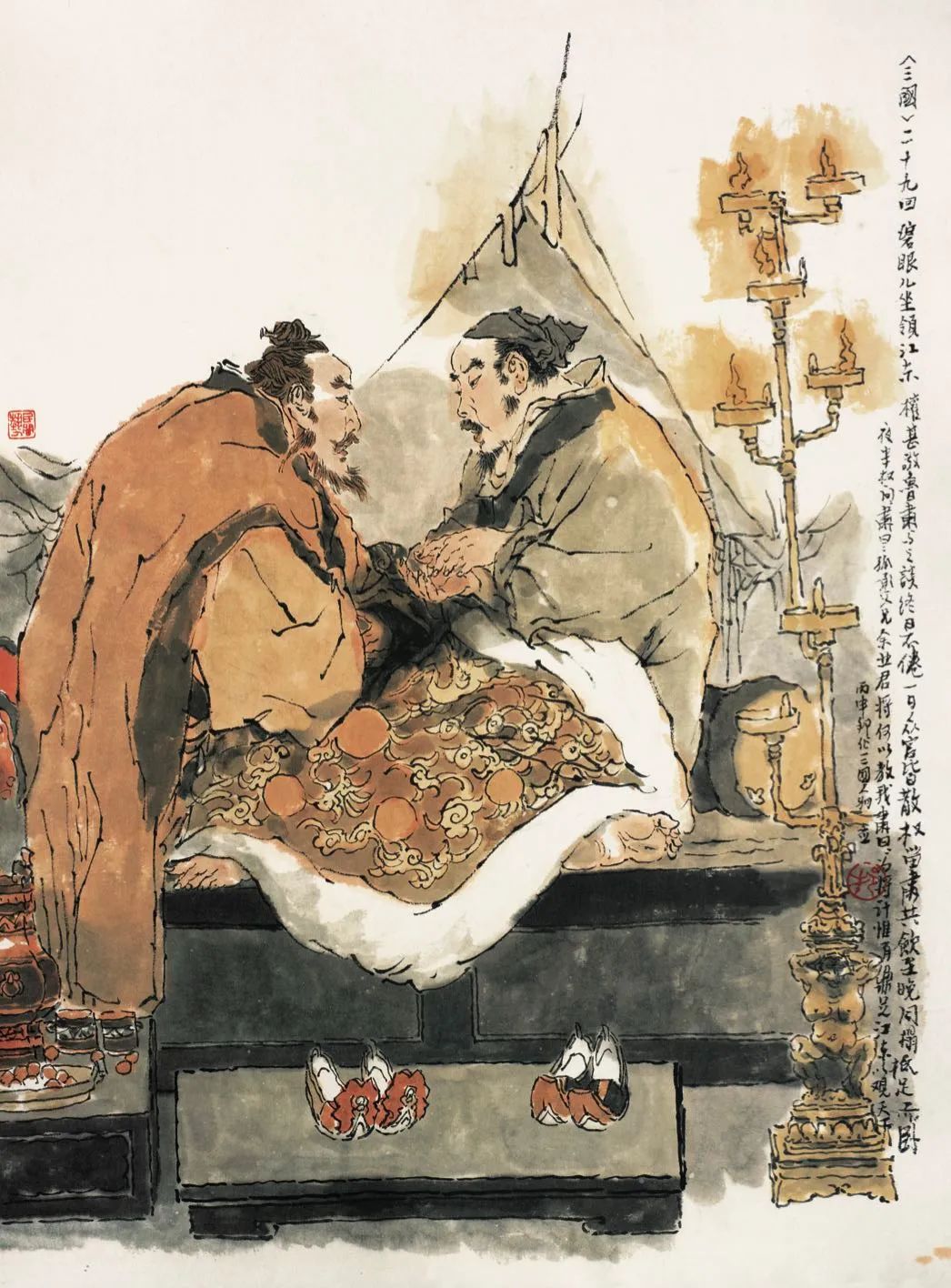
Dai Dunbang’s Illustrated Romance of the Three Kingdoms, Sun Quannashi, modern, Dai Dunbang, Chinese painting. The story comes from the twenty-ninth chapter of Romance of the Three Kingdoms: "The bully is furious in Kyrgyzstan, and the blue-eyed son sits and leads Jiangdong". After telling the story of Sun Quan’s accession to the throne, he followed the example of Emperor Guangwu of Han Dynasty and slept with Lu Su. He was not ashamed to ask questions, and celebrities gathered in Jiangdong for a while.
Sun Ce’s sudden death has disrupted the deployment of the whole Jiangdong Group. In recent years, a new voice has emerged within Jiangdong Group, that is, the theory of Jiangdong Emperor Industry with Zhou Yu and Lu Su as the mainstream. In terms of qualifications, although Zhou Yu and Sun Ce were old friends when they were young, it was three years since Jian ‘an (198) that he really joined Jiangdong Group, later than Zhang Zhao and Hong Zhang. Lu Su, a friend of Zhou Yu who lived in Yuan Shu, was recommended to join Sun Ce’s account.
With regard to the program of Emperor Industry in Jiangdong, Lu Su and Sun Quan’s On the Bed can be regarded as representative works, especially "The Han Dynasty can’t be revived, and Cao Cao can’t be killed", which clearly constructs the general policy-the Han Dynasty can’t be revived, and the imperial industry of unifying the whole country is established in Jiangdong.
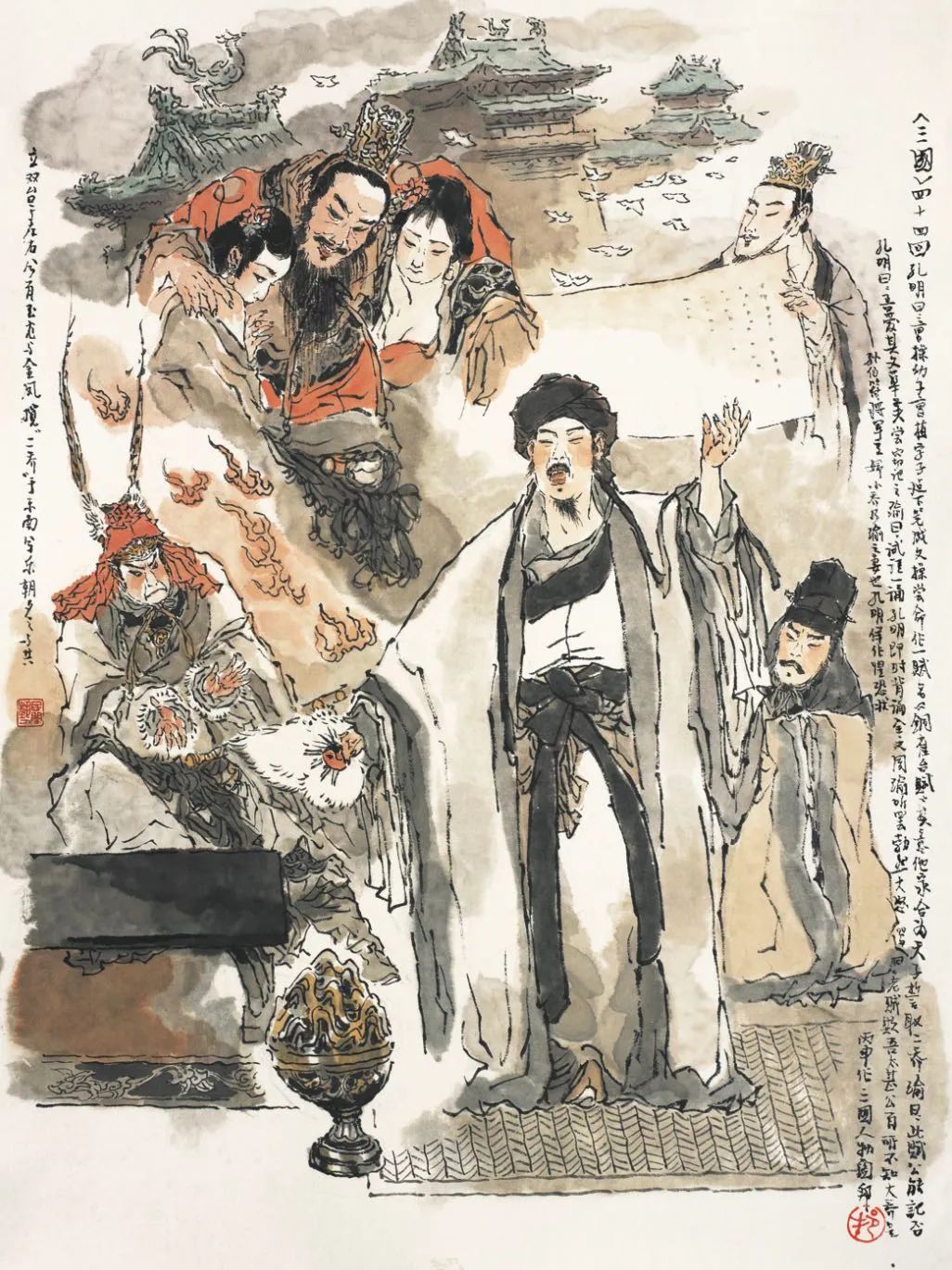
Dai Dunbang’s Illustrated Romance of the Three Kingdoms, Inspired Zhou Yu, modern, Dai Dunbang, Chinese painting. The story comes from the forty-fourth chapter of the Romance of the Three Kingdoms: "Kongming used his wisdom to stimulate Zhou Yu, and Sun Quan made up his mind to break Cao Cao". It tells that Zhuge Liang angered Zhou Yu by Cao Cao’s building of a bronze sparrow terrace to collect Er Qiao. But in the history, it never happened.
First of all, the land of Jiangdong has a successful template of Chu in history. At the beginning, Chu was sealed on the side of Jingshan Mountain, which was less than a hundred miles away. Later, they recruited talents, opened up territory, and occupied Jing and Yang, which lasted for 900 years.
Secondly, today, Sun Quan inherits the inheritance left by his father and brother, and has a large number of people in six counties. The soldiers have a lot of refined food, and the soldiers use their lives. At the same time, their products are prosperous and their hearts are stable.
Third, Jiangdong has a powerful water army, boating and raising sails, which is brave and invincible, and there is no need to worry about militarily.
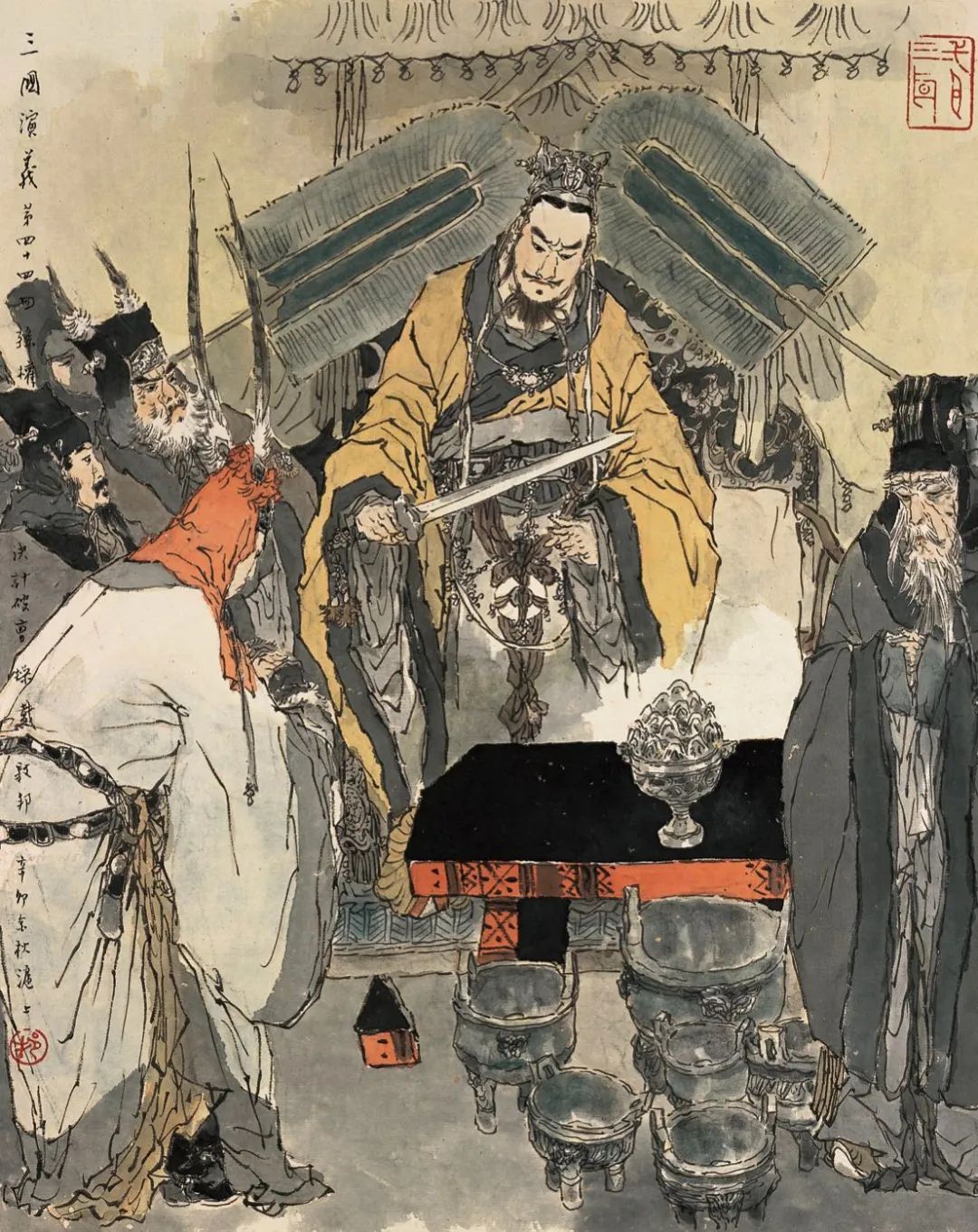
Dai Dunbang Illustrates the Romance of the Three Kingdoms, Determined to Break Cao, modern, Dai Dunbang, traditional Chinese painting. The story comes from the forty-fourth chapter of the Romance of the Three Kingdoms: "Kongming used his wisdom to stimulate Zhou Yu, and Sun Quan made up his mind to break Cao Cao". Sun Quan listened to Zhou Yu’s analysis of the situation, drew his sword and cut off the prelude, determined to fight Cao.
Zhou Yu believes that since Jiangdong has such a good foundation, there is no need to send hostages to Cao Cao to express his obedience. What’s more, when the hostages entered, it was tantamount to acknowledging the relationship with Cao Cao. Once this relationship was strengthened, Cao Cao sent a letter to the master to go north, so he had to obey and be subject to people everywhere.
At this time, Zhou Yu was only a 28-year-old young man, and his insight was far above that of many old ministers in Jiangdong.
Jiangdong entered the Zhou Yu era
For Sun Quan, Zhou Yu and Lu Su’s imperial career road is obviously more attractive, but to realize this grand plan, Jingzhou must be won. During the war in the Central Plains, Jingzhou under Liu Biao maintained peace and prosperity, and its strength should not be underestimated. If Jiangdong Group wants to forge ahead in Jingzhou, the first step is to break the old enemy Huang Zu and open the portal of Jingzhou. Since the 11th year of Jian ‘an (206), the war between Jiangdong and Huang Zu has been restarted again. Zhou Yuxian led his troops to attack Ma and Bao ‘er Tun, beheaded the enemy commanders and captured more than 10,000 people. Then Huang Zu sent Deng Long to lead his troops into Chaisang County, and Zhou Yu sent his troops to attack and won the first world war, taking Deng Long alive and escorting Wu Jun.
In the spring of the 13th year of Jian ‘an (208), Sun Quan sent his troops to crusade against Jiangxia County, and Zhou Yu was awarded as the front governor, leading the water army to attack Huang Zu. This campaign not only avenged the feud of Sun Shi in Jiangdong, but also opened the door of Jingzhou, taking the first step for Jiangdong regime to occupy Jingzhou.
This year, the situation in Jingzhou changed dramatically. First, Cao Cao officially became the prime minister, and then Liu Biao, the master of Jingzhou, died of illness. Cai Mao and Zhang Yun established Liu Biao’s youngest son, Liu Cong, as the successor of Jingzhou Pastoral, and the eldest son, Liu Qi, was furious and wanted to make an expedition, and Jingzhou Group split. Cao Cao seized the opportunity and led the army south. Liu Cong quickly surrendered, and the line from Xiangyang to Jiangling fell into Cao Cao’s hands. Most of Jingzhou was included in Cao Cao’s sphere of influence.
The buffer zone in Jingzhou is gone, and the threat from Cao Cao is close at hand. Sun Quan soon received a letter with deterrence from Cao Cao: "The water conservancy army is 800 thousand people, and Fang and the generals will hunt in Wu."
At the same time, something happened that had a great influence on Jiangdong Group-Liu Bei was defeated by Cao Cao’s army, and Zhuge Liang was ordered to cross the river and ask Sun Quan for help to express the alliance’s willingness to resist Cao.
Cao Cao said that he would "hunt in Wu", and all the ministers of Jiangdong Group were horrified. Even the veteran Zhang Zhao and others said that Cao Cao was a teacher of tigers and wolves, and Jiangdong regime was not enough to compete with him. It was better to surrender from the overall situation. In the Romance of the Three Kingdoms, Zhuge Liang argued with Confucianism and refuted Zhang Zhao and others to be speechless, which is also well-founded. In the debate of war and surrender, Zhuge Liang really succeeded in persuading Sun Quan to make him tend to unite with Liu to resist Cao. However, in the romance, Zhuge Liang’s "intellectual stimulation of Zhou Yu" based on the fact that Cao Cao built a bronze sparrow terrace to seize Xiao Qiao was nothing.
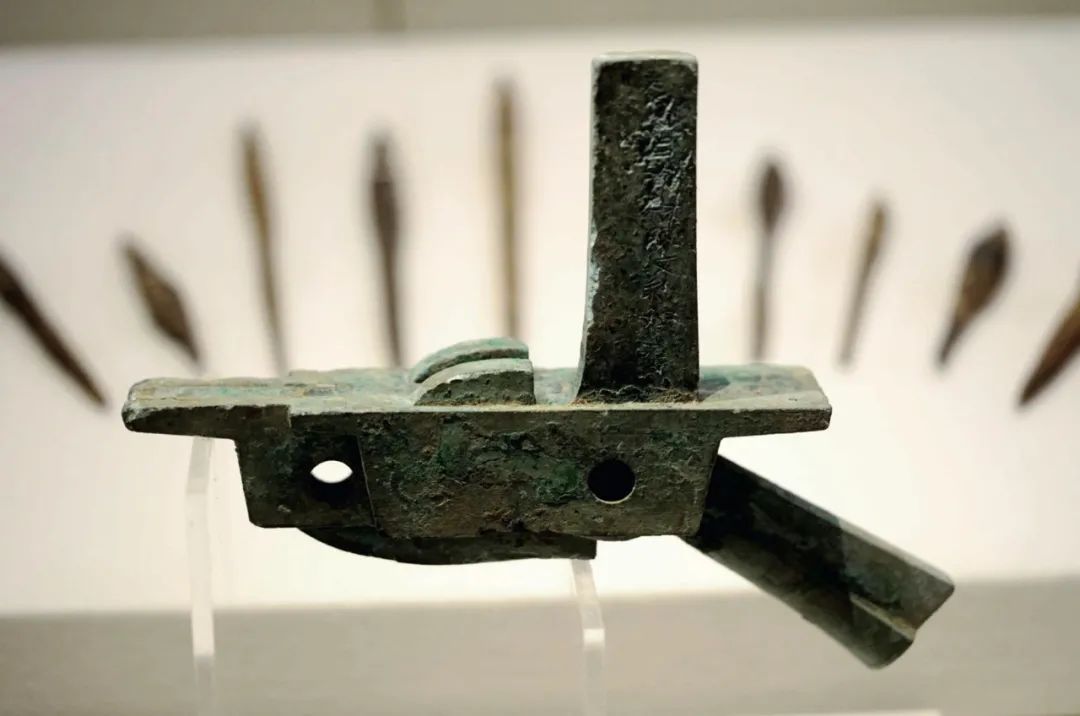
The inscription crossbow machine was unearthed from the tomb of Chibi Town. The crossbow machine looks at the mountain and engraves "A crossbow of General Lu Hou, a surname Wen Ho Chen". According to expert appraisal, it was cast in Dongwu period, with a history of about 1800 years.
The real situation is that Zhou Yu himself is a staunch advocate, but he was not in Chaisang (now Jiujiang, Jiangxi). Although Sun Quan has been persuaded by Zhuge Liang, the peace faction within Jiangdong Group has gained momentum in Judah, and Lu Su, who urged Liu Kangcao, suggested that Sun Quan recall Zhou Yu, who is also a war faction, and integrate the will of Jiangdong Group. Zhou Yu was ordered to rush back to Chaisang from Poyang Lake. The first thing he said about it was: "Cao Cao is a thief of the Han Dynasty, although he is a famous Chinese."
This is the tone of the nature of Cao Cao Group. Zhou Yu not only expressed his strong will to fight the main battle, but also told the leaders and factions of Jiangdong Group not to be intimidated by Cao Cao’s title of "Han Xiang". We fought against Cao Cao not as an enemy of the imperial court, but as a "Han thief". At this time, Zhou Yu never mentioned the idea of replacing the Han Dynasty with Jiangdong and achieving the imperial industry. Instead, he pretended to be a loyal minister of the Han Dynasty and integrated the anti-Japanese will of Jiangdong Group in the name of helping the Han Dynasty to make it justified. Hearing Zhou Yu’s analysis of the situation, Sun Quan drew his sword and cut off the prelude case: "The generals and officials dare to say that they are welcome to operate, just like this case!"
From this moment on, Jiangdong regime entered the era of Zhou Yu.
Raise an eyebrow and look at the bonfire all over the sky
In my impression, Battle of Red Cliffs, as described in The Romance of the Three Kingdoms, was a decisive battle with Cao Cao as the main attack and Sun Liu as the main defense. However, Battle of Red Cliffs in the official history is full of fog and lack of information, and many details are vague. From the limited information, it looks more like an encounter.
However, Chibi was not an accidental encounter, but an offensive campaign launched by Zhou Yu who took the initiative to lead the Jiangdong Water Army into Jingzhou. The question is coming. Compared with Cao Cao, Sun Liu’s army is in a weak position. Why not wait and wait, but dare to take the initiative to seek a decisive battle? The reasons for all this were thoroughly analyzed as early as when Zhou Yu rushed back to Chai Sang and decided on the main battle for Sun Quan.
First of all, when Cao Cao wrote to Sun Quan, he claimed that there were "800 people in the water army", which was really a bluff. But Zhou Yu, with the eyes of a military commander, saw through Cao Cao’s fatal weakness-eating too fast and indigestion. Cao Cao’s taking Jingzhou was not a slow and steady progress, but was quickly taken because of Liu Cong’s surrender. It is difficult for such a big state to consolidate its rule in a short time. Secondly, at that time, the northern soil was not safe, and Ma Chao and Han Sui lived in Kansai, which was a disaster for Cao Cao. Third, Cao Jun is good at land warfare, but weaker than water warfare. Today, he relies on the water army instead of the infantry in Jiangdong, which is based on short attack and long attack. Fourth, it’s winter, the horse has no wormwood, and Cao Jun’s expedition will inevitably lead to illness. Zhou Yu thinks that there are these four things, but Cao Cao is actually strong on the outside and weak on the inside, and he will be defeated if he rashly attacks.
In fact, Cao Cao didn’t rush to invade. He didn’t plan to conquer Jiangdong in the 13th year of Jian ‘an (208). But for Zhou Yu, the situation is urgent. Sun Liu’s allied forces are in a weak position and can only win by cleverness. He must take the initiative to seek a decisive battle in Cao Cao’s shaky footing and defeat Cao Jun in one fell swoop. If only for defensive response, although Cao Cao won’t travel south in the short term, it will be a disaster for Jiangdong if he gradually digests Jingzhou and gains a foothold.
The fighter plane was fleeting. Zhou Yu and Cheng Pu were appointed as the left and right commanders respectively, each with 15,000 chosen men. Together with Liu Beijun, they went against the river and went deep into Jingzhou to find the main force of Cao Jun. Finally, they met Cao Jun in the Chibi area of the Yangtze River (now northwest of chibi city, Hubei Province). Zhou Yu adopted the fire attack plan put forward by Huang Gai, set fire to Cao Jun’s warships, and greatly defeated Cao Cao, thus achieving a battle of winning more with fewer, winning more with weaker, and defeating stronger with stronger. Zhou Yu played a leading role in the first large-scale military operation in the Yangtze River basin, and Chibi became the most dazzling peak in his short life. This campaign made Cao Cao lose the opportunity to dominate the world in a short time, and also re-divided the pattern of Jingzhou.
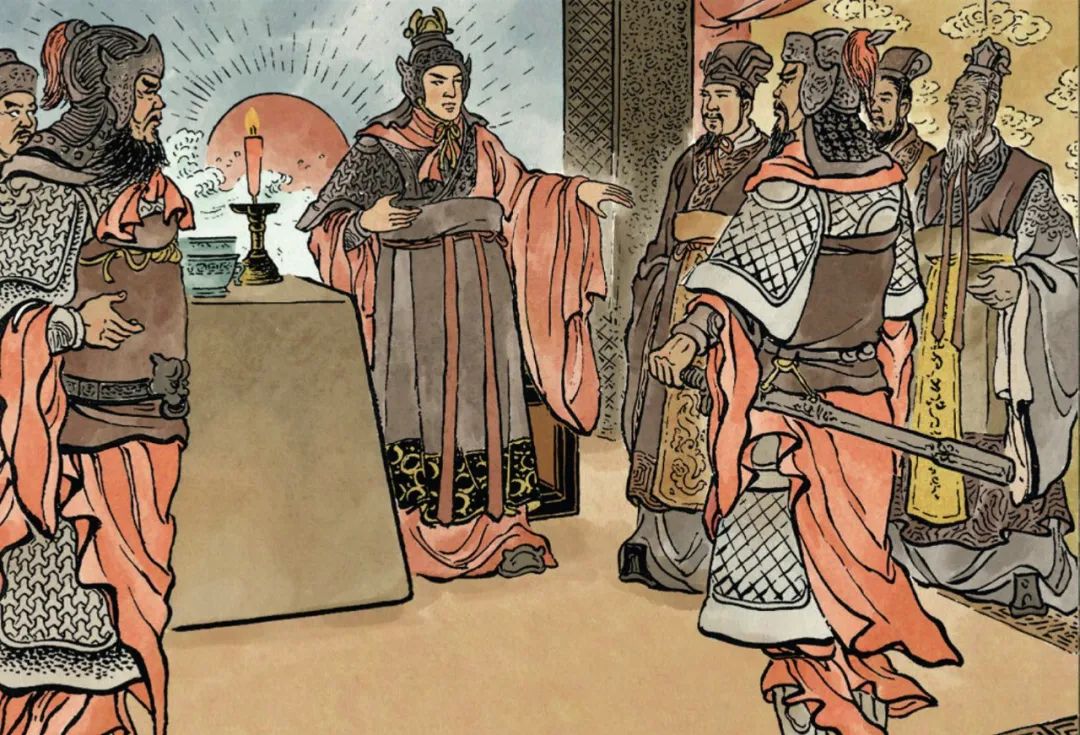
Zhou Yu and the generals in Jiangdong discussed the strategy of attacking Nanjun, which was drawn by Jiang Ping and Zhao Jin. The siege of Nanjun was the last stage of Battle of Red Cliffs. Zhou Yu led his troops to cross the river and besieged Jiangling. Liu Bei also sent troops to attack Jiangling, and Guan Yu attacked Hanshui. The two sides were deadlocked for nearly a year.
The last stage of Battle of Red Cliffs was quite long. Zhou Yu led his troops to cross the river to besiege Jiangling, and Liu Bei also sent troops to attack Jiangling. Guan Yu attacked the Hanshui River, and the two sides were at loggerheads for nearly a year. In the end, Coss worried that his retreat would be cut off by Sun Liu’s allied forces, and gave up Jiangling at the end of the fourteenth year of Jian ‘an (209), and fled north in a panic. So far, the battle was over.
After Coss’ withdrawal, Sun Quan took Zhou Yu as the satrap of Nanjun and stationed in Jiangling. At the same time, the allied Liu Bei also shared the fruits of Battle of Red Cliffs’s victory. Liu Bei made Liu Qi the shepherd of Jingzhou, and then quickly conquered Wuling, Changsha, Guiyang and Lingling counties, with Zhao Yun guarding Guiyang and Liao Li guarding Changsha. With the resurgence of Jingzhou, new challenges have followed.
Unfinished ambitions
After Battle of Red Cliffs, the forces of Cao, Liu and Sun San gathered in Jingzhou, and parts of Xiangyang, Nanyang and Nanjun in the north of Jingzhou were still under the control of Cao Jun; Sun Quan controlled the important places along the Yangtze River. Liu Bei occupied four counties, although the territory was large, but the geographical position was embarrassing, there was no export, and the development was extremely limited. Therefore, Liu Bei has been trying to improve his situation by diplomatic means. Soon after, Liu Qi died of illness, and Liu Beiling was herded in Jingzhou. Sun Quan agreed to let him be stationed in Youkou. Because Liu Bei’s official position was General Zuo, he was called Zuo Gong, so he renamed this place as Public Security.
Geographically, the police station stationed by Liu Bei is very close to Zhou Yu’s Jiangling, only a few tens of kilometers. Now Zhou Yu has to face a huge challenge-he has led the Southern County prefect, so he naturally wants to use this as a foundation to expand his influence, and finally achieve the goal of making Jiangdong span Jing and Yang. But the problem is that although Cao Cao has returned to the north, there is an ally Liu Bei in the middle. Neither Zhou Yu himself nor Jiangdong Group has the same influence in Jingzhou as Liu Bei. What worries Zhou Yu even more is that Liu Bei began to quickly integrate resources in Jingzhou, recruiting talents and talents, and absorbed a large number of military commanders such as Huang Zhong, Wei Yan, Ma Liang and Huo Jun, and his reputation was growing day by day. No one can see all this more clearly than Zhou Yu who is close at hand.
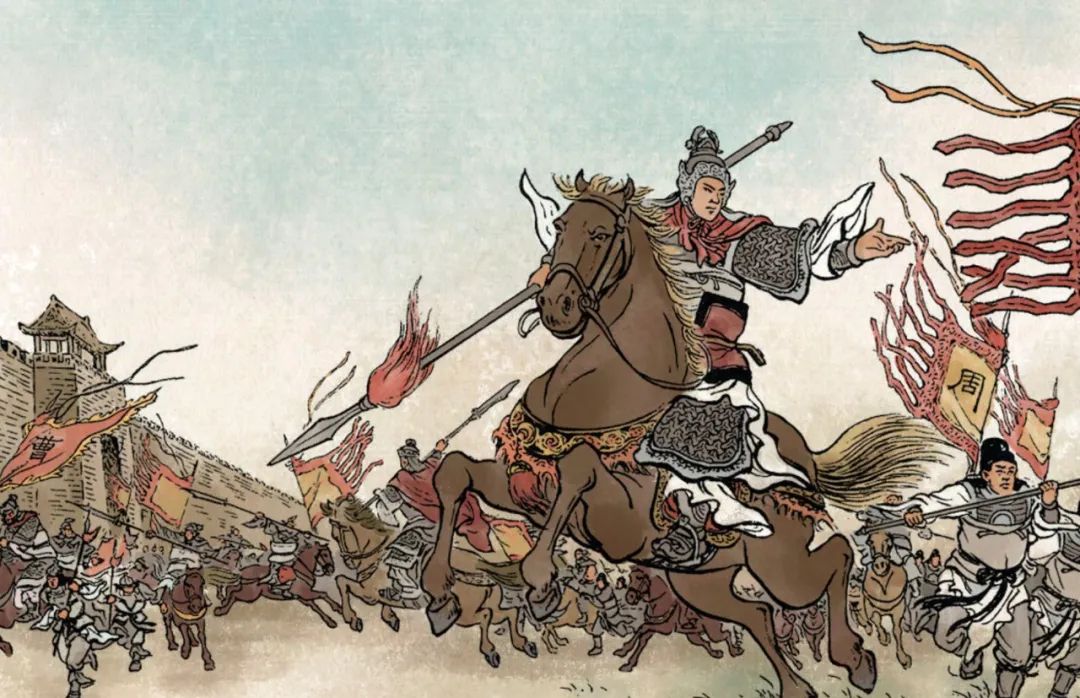
Zhou Yu led an army to attack Nanjun, which was written by Jiang Ping and Zhao Jin. Under the attack of Sun Liu’s allied forces, Coss abandoned Jiangling at the end of the 14th year of Jian ‘an (209) and fled north in a panic. After Coss withdrew, Sun Quan took Zhou Yu as the prefect of Nanjun and stationed in Jiangling.
In view of Cao Cao’s great pressure in the north, Sun Liu’s alliance re-divided responsibilities. Even if Sun Quan was unwilling, he could only accept the fact that Liu Bei was very influential in Jingzhou. Therefore, while he led Jingzhou, Sun Quan led Xuzhou. At this time, Xuzhou was still under the control of Cao Cao, and the division of Sun Liu’s joint army meant that Sun Quan would dominate the strategy of Xuzhou in the future, while Jingzhou was mostly handed over to Liu Bei. This arrangement, the most embarrassing position is undoubtedly Zhou Yu, the satrap of the southern county. Once Jingzhou falls into the hands of Liu Bei, it also means that his plan to open up Jingzhou and then move northward will be lost.
In order to save the Jingzhou game, Zhou Yu decided to take risks. He wrote to Sun Quan, saying that "Liu Bei has a lean posture, while Guan Yu and Zhang Fei are the generals of Xiong Hu, and they will not be used for a long time." He suggested giving Liu Bei a sugar-coated cannonball, giving him a big house, giving him a beautiful woman, killing his will, putting him under house arrest, and bringing Liu Bei to Guan Yu and Zhang Fei. However, this plan was opposed by Lu Su. After all, once Liu Bei was placed under house arrest, the alliance between Sun and Liu would be in danger of breaking up. After Battle of Red Cliffs, there were differences between Zhou Yu and Lu Su. Lu Su believed from beginning to end that only the alliance of Sun and Liu could fight against Cao Cao. Zhou Yu believes that in the process of realizing the imperial industry, it is not necessary to unite Liu; Sun Quan thought that Cao Cao was still a great threat and the alliance could not be broken, so he adopted Lu Su’s opinion and did not put Liu Bei under house arrest.
In several rounds of games in Jingzhou, Zhou Yu was in a passive position, but he did not give up his last fight. In the fifteenth year of Jian ‘an (210), Zhou Yu brewed a more ambitious plan. The plan first involves going to Shu with Sun Yu, the general of Fenwei (cousin of Sun Quan) to take Yizhou, which coincides with the strategy of "crossing Jing Yi" in Zhuge Liang’s Longzhong Dui, and is the route of Liu Bei Group in the near future. Secondly, Zhou Yu, an ally, mentioned the signing of aid with Xiliang Ma Chao. The third is the Northern Expedition. Zhou Yu plans to attack Xiangyang together with Sun Quan, and then make progress in the north to achieve the imperial industry.
In the impression of ordinary people, I always feel that Soochow can only be used as a golden supporting role. However, in Zhou Yu’s era, Jiangdong, which was surrounded by tigers and dragons, had the ambition to swallow heaven and earth, dared to win the Central Plains and compete for the world. It’s a pity that every day is a holiday. When Zhou Yu was preparing to go back to Jiangling to implement this grand plan, he fell ill and died while passing through Baqiu, at the age of 36.
Comment on the reunion of clouds and winds
Zhou Yu’s death brought Jiangdong Group to an abrupt end, with its grand plan of marching in the Northern Expedition to unify mountains and rivers.
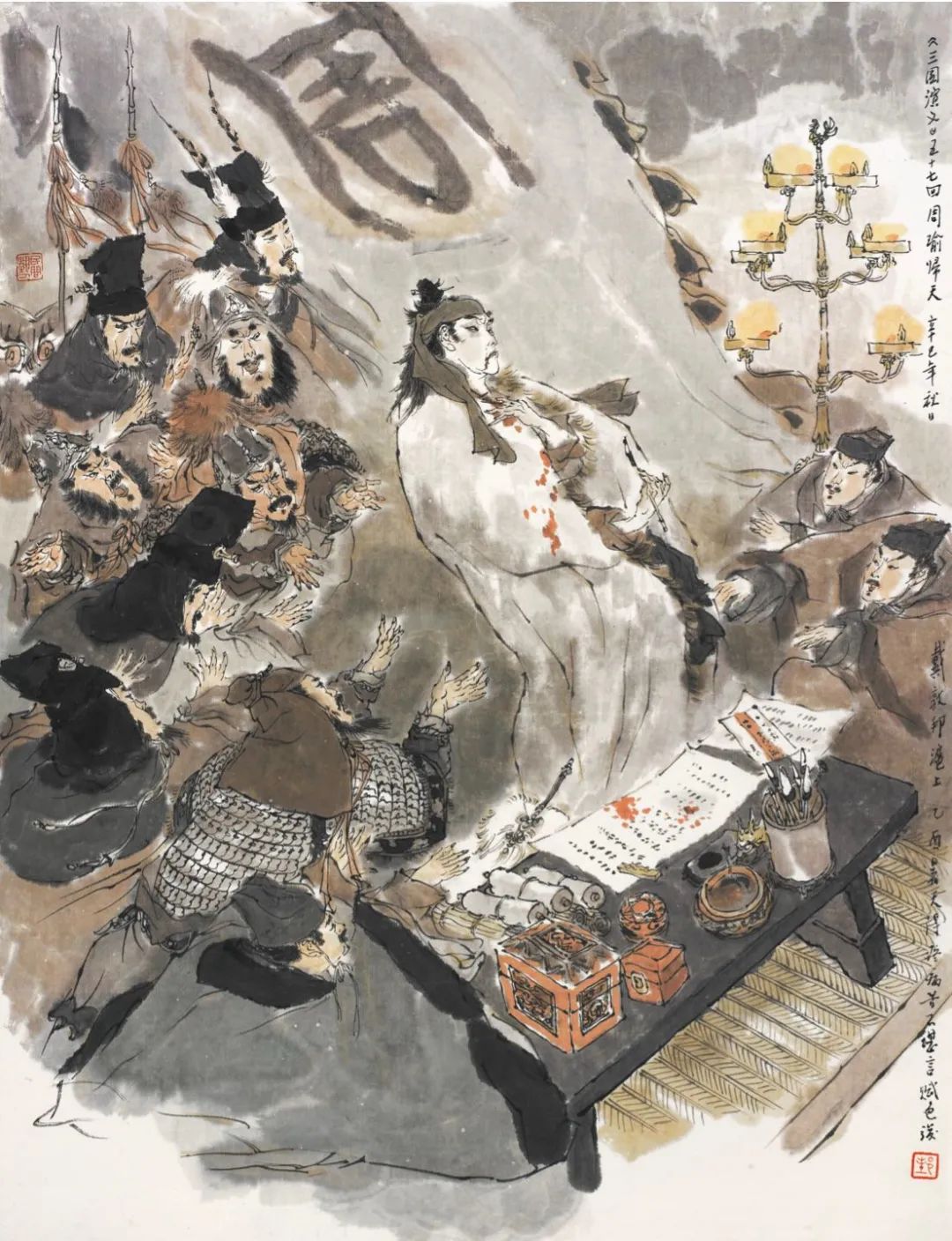
Dai Dunbang Illustrates the Romance of the Three Kingdoms and Zhou Yu Dies in Heaven, modern, Dai Dunbang, traditional Chinese painting. The story comes from the 57th chapter of Romance of the Three Kingdoms, "Chai Sangkou mourned in Wolong, director of Feng Chu in Leiyang County". Zhou Yu died of Kong Ming’s "three qi" in the romance, but died of illness in the official history. Zhou Yu was injured in the battle in Nanxian County, which may also be one of the reasons for his early death.
The brilliant general star has fallen in the late Eastern Han Dynasty, and Zhou Yu’s death is undoubtedly a great loss to Sun Quan, but Zhou Yu’s influence on Jiangdong regime and even the pattern in the late Han Dynasty still exists. After the Red Cliff, the trend of one-third of the world gradually became, and Sun Quan was also on the journey of imperial industry step by step. Many years later, Sun Quan occupied Jingzhou. When talking with Lu Xun about the past, he still remembered Zhou Yuyingzi and sighed: "Gong Jin was heroic and courageous, so he broke Meng De and opened up Jingzhou."
When Sun Quan was crowned as the Emperor of Soochow, he recalled Zhou Yu with the same emotion: "Being alone is not Zhou Gongjin, not the emperor."
872 years after Zhou Yu’s death, in the fifth year of Yuanfeng in Song Shenzong (1082), Su Shi went boating on the Yangtze River outside Huangzhou City. When he saw the surging waves of the Yangtze River, the east wind dyed half the rouge color, thinking of Zhou Lang’s heroic posture in the red cliff bonfire, he began to write a book and wrote the historic masterpiece Niannujiao Red Cliff Nostalgia:
The endless river flows eastward, with its huge waves,gone are all those gallant heroes of bygone years. In the west of the old camp, people said that it was the battle of the three kingdoms, the battle of the red cliff. Rocks and clouds break, waves break the shore, and thousands of piles of snow are rolled up. The majestic river shan qi, such as the picture, how many heroic heroes emerge at a time.
Thinking back in the days of Zhou Yu’s spring breeze, beautiful beautiful young Joe just married him, his heroic heroic spirit full of. Hand feather fan head in a white figure, laugh and talk, the enemy’s warships burn the ashes. I am fugue today in the battlefield, I am feeling the a feeling heart, prematurely born with white hair. Life is like a dream, and one bottle returns to the moon.
END
Author Zhou Yu
Editor | Zhan Qianhui
Proofreading | Li Dong
Typesetting | Li Yuan
Original title: "The most familiar stranger in the Three Kingdoms: Zhou Yu in history, how did you imagine Jiangdong Diye?" 》