From the flash to the first store, this year’s star street brand actively went offline.
At the end of 2023, ACE-YKYB, a clothing brand headed by Z.TAO, opened its first offline store in Hangzhou Yaowang X27 Theme Park. The overall design was mainly gray and white, focusing on young trends. ACE-YKYB, whose full name is YOUNG KING YOUNG BOSS, was founded by Z.TAO and his team in 2019.
It is nothing new for stars to enter the clothing industry and create personal brands. According to incomplete statistics, at least 20 personal fashion brands created by domestic stars are active in the market.
In 2023, under the upsurge of physical consumption, old brands returned to the market, new brands actively explored offline, and star street brands gradually recovered.
At the same time, there are still star street brands closing stores and withdrawing from the market. Just like the ever-changing popularity, traffic is easy to disappear, and star brands are always short-lived and criticized for "cutting leeks". How to find a long-term development model is a common problem in the industry.
one
There are still star street brands shrinking in closing stores.
As early as 2003, CLOT, founded by Edison Chen, had brought a wave of entertainment stars from Hong Kong, Taiwan and the mainland to create personal brands. The trendy brands that appeared at that time-PHANTACi from Jay Chou, STAYREAL from A Xin in May and MADNESS from Shawn Yue-were still active in the market.
In the next twenty years, more and more star fashion brands were just a flash in the pan, and after a short boom, they gradually fell silent and were finally forgotten. For example, DUEPLAY in Ryan, WDMD in Bao Beier, and STAGE…… in Show Lo … have all become history, and some once-hot brands have inevitably declined.
Looking back on 2023, there are still star street brands shrinking in closing stores. At the beginning of the year, Shawn Yue’s personal brand MADNESS, which was founded nine years ago, adjusted its business line, and the online Tmall flagship store stopped operating. Subsequently, its first offline store in Sanlitun, Beijing, and the only brand direct store in the mainland also closed.
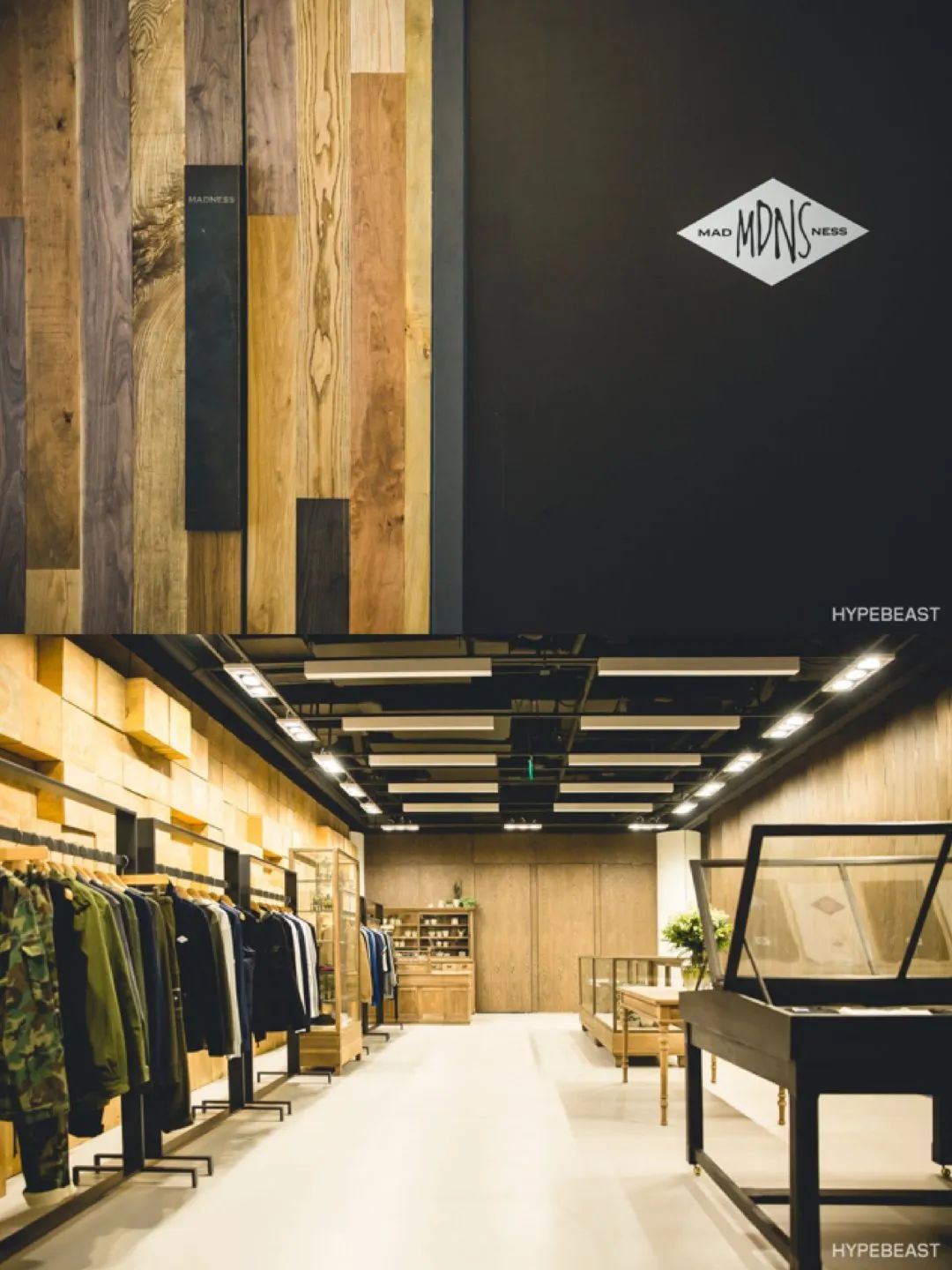
Source: HYPEBEAST
In June, YCY withdrew from the ranks of shareholders of Shanghai Rixin Yueyi Brand Management Co., Ltd., a subsidiary of BABT, and actually withdrew from the brand; The first offline life concept store of CANOTWAIT_, a trendy brand founded by William Chan, which landed in Shanghai in 2022, has not been searched at present.
Before that, in 2022, the star street brand experienced a fierce tide of closing stores. In July 2022, SMUDGE, a JJ Lin trendy clothing brand that once opened physical stores in shanghai new world and Wuhan centers, closed its last store in Changle Road, Shanghai, leaving only online sales channels.
On May Day, STAYREAL, a trendy brand founded by A Xin and illustrator Buerliang, closed the Xidan Joy City store and withdrew from the Beijing market. At its peak, STAYREAL once had more than 40 stores, and now there are only five, located in Shanghai, Guangzhou, Changsha and Suzhou.
Also in 2022, Edison Chen’s personal brand JUICE closed its stores in Taikooli in Beijing and Taikooli in Chengdu. At present, there are only three stores in China, namely Shanghai, Chengdu and Guangzhou, and the goal of "opening 50-100 stores" has long been dashed.

Source: CLOT official website
At the same time, new brands are emerging. At the end of 2022 and the beginning of 2023, Nana Ou-yang’s personal brand nabi and Dylan’s personal brand D.Desirable appeared one after another.
New brands are emerging quickly, and "rollover" is also fast. The first product series "Yunduo Capsule Series" launched by nabi, a personal brand in Nana Ou-yang, is hotly debated because of its high price and low quality. The rabbit ear bathrobe with a price of 998 yuan is made of 86% polyester fiber, and the product pricing is seriously inconsistent with the material price.
Pricing and quality issues are the core of the long-term criticism of star street brands. At the same time, Lu Han’s trendy brand U.G.C was also hotly searched for pricing and quality issues. A blogger commented: "The clothes with a price of 1,500 yuan are full of threads, and the lathe work is poor, and there are broken lines everywhere. It is estimated that the cost of one piece is only 60 yuan."
On January 2nd, in the notice of Shanghai Municipal Market Supervision Bureau, a short down of DANGEROUS PEOPLE brand was notified because it failed to meet the filling standard requirements, which easily affected the normal hormone secretion of human body. DANGEROUS PEOPLE brand is a menswear brand launched in Joker Xue in 2015.
The research of iResearch once pointed out that more than 70% consumers are willing to pay a premium below 30%, and young people are more willing to pay a high premium above 30%. Stars have their own appeal, self-created brands often have a premium, and fans-based audiences are also willing to pay the bill. The excessive premium of some brands has exceeded the acceptance of consumers and fans, and young consumers are becoming more and more rational.
A long-term fan who bought the brand’s trendy brand products told the brand that idolize’s buying trendy brands means that fans pay for emotional value, and it is understandable to pay a higher premium. However, high prices and low quality can easily arouse fans’ resentment and be regarded as disrespecting fans, thus affecting the star’s personal image.
In her view, young consumers have become more and more rational, especially the fan groups are more and more familiar with the operation mode of the star economy. Most fans will no longer take it all without brains, and they will still consider the cost performance when buying star fashion products, especially the quality of products.
2
Flash+physical store, actively explore offline
In addition to the frequent contraction and controversy of closing stores, there are also some positive new trends in 2023.
According to the number of brands, most of the current active star street brands have opened physical stores, which are operated online and offline at the same time. With the recovery of offline consumption, star street brands have been actively deploying offline physical retail since last year.

South Korean actress Jessica’s personal brand BLANC&ECLARE is frequently distributed in the China market. In November 2022, China opened its first store in Vientiane World, Suhewan, Shanghai, and then quickly landed its second store in Hefei.
In 2023, BLANC&ECLARE opened its first stores in Beijing and Xiamen successively. According to the brand official website, BLANC&ECLARE also plans to expand in more than 10 cities including Chengdu, Xi ‘an, Nanning and Xiamen.
We11Done, the personal brand of Korean singer G-Dragon’s sister Quan Damei, is also one of the trendy brands that expand the offline retail layout frequently in recent two years.
According to the big data of Win Business, We11Done has opened 14 stores in shopping centers and department stores with an area of more than 50,000 square meters in 24 cities across the country, and has floor-to-floor brand stores in the core business districts of Beijing, Shanghai, Shenzhen, Hangzhou, Chengdu and other cities.
In June, 2023, STAYREAL, a A Xin street brand that left the Beijing market for one year, returned in the form of STAYREAL PARK theme limited stores, introducing limited clothing and interactive experience devices, and then STAYREAL PARK theme limited stores were held in Shanghai, Guangzhou, Xi ‘an, Chengdu and other cities.
For more brands, compared with the heavy investment of long-term stores, the rental cost and operation and maintenance cost of curation and flash are lower, which is the priority choice for many star street brands.
Team Wang design, a brand with Jackson Wang as the manager and creative director, has been actively deploying flash in the world in recent two years, and has opened the concept space of the lower line limit in Shanghai, Shenzhen, Chengdu, Bangkok, Singapore and other places.
The location of pop-up shop is more flexible, and many brands will choose the core business district where the passenger flow in first-tier cities gathers, and at the same time play the role of marketing and publicity.
For example, Team Wang design’s time-limited concept stores are opened in the trend business districts of first-tier cities such as Shanghai TX Huaihai, Chengdu IFS and Shenzhen Vientiane Tiandi, and giant devices are often arranged in the stores to attract punch cards to break the circle.

Source: Team Wang design
At the same time, flash is also a test of physical stores under the landing line, which provides reference for the location of subsequent stores. GOODBAI, a brand founded by Bai Jingting and well-known domestic designer Shangguan Zhe, opened nomadic stores "Good Time Park" in Vientiane Tiandi, Paris and Singapore before the first physical store in Yanqing Road, Shanghai.
It is worth mentioning that star street brands gradually expand from clothing to more categories, such as dolls, ornaments, daily necessities, etc., from clothing brands to "fashion and lifestyle brands", and offline space is becoming more and more diverse.
For example, William Chan’s brand CANOTWAIT_ has also launched products such as masks, water cups, cultural creations and fragrances; GOODBAI is positioned as a "clothing and lifestyle brand". Both its stores and pop-up shop emphasize relaxed and comfortable living scene layout, and provide special coffee and co-branded desserts in the stores.
During Halloween last year, TEAM WANG design also held Halloween activities with the theme of Under the Castle in Shanghai, including Halloween themed secret rooms and outdoor Halloween fairs, which attracted wide attention.
The star’s own brand itself has a strong cultural attribute. The cross-border opening of secret rooms, markets and other forms is essentially to cater to young people’s favorite consumption formats, gain insight into the youth culture where fans are located, and convey lifestyle trends.
three
Explore the long-term development model
From a broader perspective, both domestic and international fashion brands are flooding into the market.
Domestic trendy brand stores such as Randomevent and ROARINGWILD have successively opened their stores into the core business of the city. The data shows that Randomevent stores have covered many cities such as Shanghai, Beijing, Chengdu and Changsha. ROARINGWILD has 9 stores in Beijing, Shanghai and Shenzhen.
Meanwhile, Supreme, an internationally renowned fashion brand, plans to open the first independent store in China market at No.291 Fumin Road. At present, the block has erected a large enclosure, and Shanghai will welcome Supreme’s 17th store in the world.
According to the consulting firm Frost & Sullivan, by 2025, the market size of China trendy retail industry will reach 475 billion yuan. As one of the gold diggers, star street brands still have great market prospects.
A core pain point is that the brand is highly dependent on the popularity of the stars themselves. Without the awareness of long-term development, the brand will soon die with the loss of popularity.
In the view of Cheng Weixiong, an independent analyst in shoes and clothing industry and founder of Liangqi brand, fashion brand is the lifestyle brand that best represents the fashion trend. It is not enough to rely solely on the appeal of stars. It is necessary to be more creative in product research and development, to show the channel selection in the latest channel where young users gather, to go to shopping centers offline, and to learn new marketing methods such as planting grass online to promote users’ reach.
Cheng Weixiong is optimistic about the future development of street brands: there is room for street brands, but to truly recognize the originality of street brands, rather than the homogenization of’ simple price increase+celebrity endorsement’, the individuality and differentiation of users need the materialization of lifestyle.
In 2023, some star street brands also received attention and began to enter the mainstream market. In November, TEAM WANG design officially launched the cross-border cooperation project capsule series "DONG" with FILAfusion, a trend sports brand owned by Fila, with Jackson Wang as the creative director.
Whether this star tide brand can survive for a longer time, let us wait and see.