"Going to school in the cloud" is inseparable from how to protect children’s eyesight during the epidemic of mobile phones and computers.
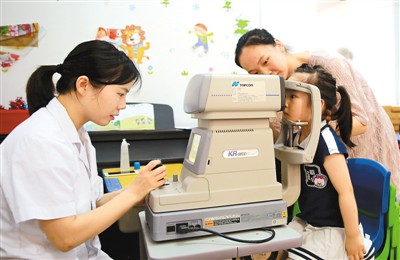
In recent years, with the increasing myopia rate of children and adolescents, how to effectively prevent myopia and protect eyes in like eyes has attracted much attention. Jishui County, Ji ‘an City, Jiangxi Province, organized a professional medical screening team to come to schools and kindergartens recently to provide children with eyesight tests and file the children’s eye health. Liao Min photo
Zhi Zhao Zhu Huiqing wrote
The COVID-19 epidemic has changed people’s way of life and students’ way of learning. There are fewer outdoor activities, more TV and computers, and online classes become the norm. Whether adults or children, the main learning and entertainment have become using computers, playing mobile phones and watching TV. Using your eyes at close range for a long time undoubtedly aggravated the damage to your eyes.
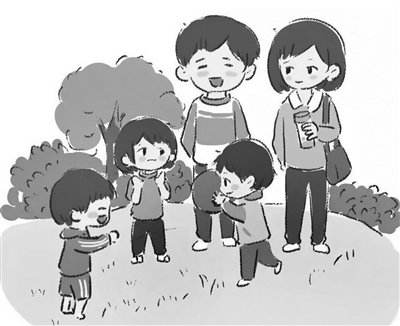
Recently, the National Health and Wellness Commission issued the Guidelines for the Prevention of Myopia among Children and Adolescents during the COVID-19 Epidemic (hereinafter referred to as the Guidelines), which specifically mentioned that outdoor sports should be increased. According to relevant sources, proper outdoor exercise can not only improve children’s health, but also play a key role in the prevention and control of myopia among children and adolescents.
Increase daytime outdoor activities
Relieve excessive eye use at home
During the COVID-19 epidemic, home schooling became an important way for children to learn. Ms. Liang, a parent of a junior two student, said that children used to have physical education class every day at school, and they could exercise by walking on the way to and from school. Although they read books for a long time, they sometimes have a rest, but now they are bored at home staring at their mobile phones and tablets, having live classes, submitting and revising their homework every day. The child’s eyesight has become blurred, which makes her very worried.
Experts say that daytime activities can not only prevent myopia, but also control the development of myopia for children who have already developed myopia. The "Guidelines" specifically mentioned that it is necessary to increase children’s outdoor activities and advocate increasing outdoor activities in open, ventilated and sparsely populated places, which is conducive to preventing myopia. This is not contradictory to the prevention and control of the epidemic, but it is necessary to do a good job of prevention and control.
First of all, children should try to avoid close contact with others when they are outdoors, and wear masks when they need to communicate with other children or others. Second, young children should be accompanied by adults for outdoor activities. At the same time, parents should pay attention to children’s hygiene, especially hand hygiene, and be sure to tell children not to touch their eyes, nose and mouth with their hands. Third, children should not spit everywhere during outdoor sports. When sneezing and coughing, they should pay attention to covering their mouth and nose with paper towels and elbows. Fourth, take off your coat and wash your hands in time after going home from outdoor sports.
Choose regular electronic products
Anti-blue light equipment is not necessary
Mr. Yang, a citizen of Beijing, bought the latest tablet computer and anti-blue-light glasses in order to make his children’s online classes not hurt their eyes. Although the expenses are not small, he thinks it is worthwhile for their children’s eyesight.
In this regard, experts suggest that the selection of video tools should adhere to the principle of "rather big than small", and the order of selection is projection, TV, computer, tablet computer and mobile phone. Improper screen size, display screen refresh rate and use distance can also easily lead to visual fatigue, and then cause eye diseases such as myopia or dry eye, while the resolution of the display generally does not cause visual fatigue, so it is suggested to set the parameters of the screen: the height should be kept at a level or slightly lower position in the eyeball and video center; The distance is 4-6 times of the diagonal length of the electronic screen; The refresh rate of CRT display screen of cathode ray tube is generally 75-85 Hz. If it is a liquid crystal display screen, there is no need to adjust the refresh rate. In addition, the ambient light should be suitable. When using electronic products at night, it is necessary to turn on the light and dim the brightness of the screen to 30%. Screen saver wallpaper with green background can be set to relieve eye fatigue.
Wei Wenbin, director and chief physician of the Department of Ophthalmology of Beijing Tongren Hospital, said that there is an over-interpretation of the harm of blue light in the society at present, and there should be no direct relationship between the prevention of blue light and visual fatigue and the prevention and control of myopia. Blue light can be divided into long-wave blue light and short-wave blue light. Only short-wave blue light will affect eye health, but it needs long-time, high-intensity and uninterrupted irradiation. The electronic products that pass the quality inspection have filtered harmful short-wave blue light. Therefore, in daily life, there is no need to install anti-blue light equipment when using electronic products produced by regular manufacturers.
Tables and chairs match the height of children.
Try not to use the dining table instead.
The desks and chairs that match the height of children can protect eyesight and prevent myopia. Inappropriate tables and chairs will have a great impact on sitting posture and sight distance, leading to diseases such as myopia and spinal curvature. During the epidemic period, a large number of students studied at home, not equipped with special desks and chairs, and some used dining tables, dining chairs or beds instead.
In this regard, Guo Xin, director of the School Health Center of Beijing CDC, said that the dining table and dining chair are often too high, while the bed is soft and low, which cannot replace the regular desks and chairs.
For families with adjustable desks and chairs, according to the height of children and the height range table of various models of desks and chairs for primary and secondary school students, the table height and seating height suitable for children can be found. According to this principle, the thighs and calves should be vertical, the back should be straight, the upper arms should droop, and the elbows should be 3-4 cm below the desktop to correct the desks and chairs. Families without adjustable desks and chairs should also make adjustments according to the above principles. When the table or chair is too short, the table or chair should be raised.
Eye movement exercises are limited.
And don’t rely on eye drops.
Xiao Gang, a 10-year-old, stayed at home for online classes during the epidemic, staring at the computer for a long time during the day, often watching TV and playing games after studying, and sometimes staying up late to read books. Recently, the mother found that her son began to blink frequently, and there were always secretions in his eyes, and he rubbed his eyes from time to time. Xiao Gang’s mother is very worried.
The eyeball is like a camera. To take a clear picture, you need to focus on the negative. The process of focusing is called adjustment, which depends on the movement of the muscles in the eye. Looking near is like spring contraction, that is, adjusting tension, while looking far is spring relaxation, that is, adjusting relaxation. Excessive adjustment may lead to myopia. Increase outdoor activities, increase the time to see the distance, you can effectively relax the adjustment.
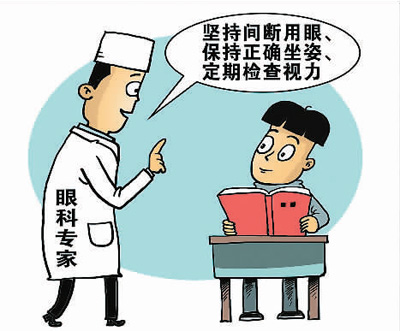
Wei Wenbin said that during the epidemic period, there were some "winking", "slanting head and slanting brain" and various eye exercises focusing on eye movement. This kind of exercise is actually the exercise of extraocular muscles, which is helpful to some children with oblique amblyopia who need to train their binocular vision function, but it can’t relieve the fatigue of intraocular muscles well, so it can’t slow down the development of myopia and visual fatigue. To prevent and control myopia, we should emphasize the formula of "20-20-20", that is to say, look for nearly 20 minutes and look at 20 feet (6 meters) for more than 20 seconds, so as to relax the muscles in the eye and relieve visual fatigue.
At present, there is no drug promotion to improve vision and control the development of myopia in China. In recent years, studies have found that low concentration of atropine can delay the development of myopia in children. However, the low concentration of atropine eye drops is not a magic medicine. Some children will be afraid of light, unable to see clearly at close range, and allergic reaction to atropine. There are still some children who can’t effectively control the progress of myopia. So don’t rely on eye drops to prevent and control myopia, reduce the use of eyes at close range, pay attention to eye posture and increase outdoor exercise are the most important ways to prevent and control myopia. At the same time, we should go to the hospital early for health examination, monitor the occurrence and development trend of myopia and intervene in time.
High myopia or blindness
Wearing glasses is the most effective way to delay
Experts suggest that preschool children should be more strict with the use of electronic screens than school-age children, and the use of electronic products should be minimized. The time for watching cartoons should not exceed 15 minutes at a time, and the cumulative time should not exceed 1 hour every day; Ensure more than 10 hours of adequate sleep, balanced nutrition, no picky eaters, no overeating, eat less sugar, eat more fruits and vegetables, and drink no less than 1500 ml of water every day; Choose an appropriate sport or game.
Wei Wenbin emphasized that myopia can’t heal itself. Some high myopia above 600 degrees is pathological myopia, which is an important cause of blindness. The most critical purpose of juvenile myopia treatment is to prevent it from developing into high myopia and pathological myopia. Therefore, once myopia is diagnosed, it should be intervened.
It is recommended to wear glasses when the degree is greater than 100 degrees. First of all, we should go to the hospital for identification. After ciliary muscle paralysis, mydriasis and optometry can distinguish true myopia, asthenopia and pseudomyopia. True myopia cannot be recovered by means of instrument training, and there is no effective cure at present. The reason why instrument training improves vision may be that the patient is pseudomyopia, or that the naked eye vision is improved by training ciliary muscles. However, this state of myopia has not been lifted, so there is no way to stop the rapid development of myopia.
It is said on the Internet that children with low myopia get worse after wearing glasses, which is a natural development of myopia, not caused by wearing glasses. It is the simplest, safest and most effective way to delay this process by wearing appropriate glasses. With the improvement of the epidemic prevention and control situation, it is now possible to go to the hospital for optometry and glasses. When visiting a doctor, we should pay attention to strictly implementing epidemic prevention measures, make an appointment for optometry in advance, see a doctor at different times to reduce gathering, wear a mask for protection, and cooperate with the examination according to the doctor’s advice.
interlinkage
Attention should be paid to the vision problems of the elderly
According to the 45th Statistical Report on the Development of Internet in China, by March 2020, the number of Internet users in China had reached 904 million, and the number of mobile phone users had reached 897 million. Among netizens, netizens aged 50 and above account for 16.9%, and the number exceeds 150 million. The Internet continues to penetrate into middle-aged and elderly people.
Today, with the rapid development of the mobile Internet, the use time of small-screen mobile terminals for the elderly has doubled, which has greatly enlarged the eye problems of the elderly in the small-screen era. Many of them suffer from vision problems such as cataracts or glaucoma. According to the statistics of Ophthalmology Branch of Chinese Medical Association, the incidence of cataract in people aged 60 to 89 in China is about 80%, and the incidence of cataract in people over 90 years old is as high as 90%. Cataract patients are often accompanied by blurred vision, ghosting, photophobia, glare, dark shadows in front of their eyes, deepening myopia and other symptoms. Without surgical treatment, they may eventually become blind, which will seriously affect their normal work and life.