The wave of children’s beauty bloggers should be "braked"
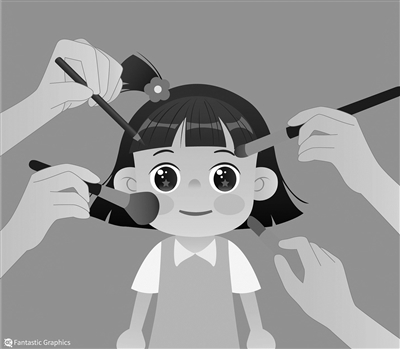
Teaching make-up, experience generation, and pit prevention, some reliable beauty bloggers are the hearts of many beauty lovers, and are also favored by many beauty brands. However, this beauty trend has blown to children prematurely. On the social media platform, a group of children’s "online celebrity" appeared with gimmicks such as "the smallest beauty blogger in the whole network" and "learning makeup with cute baby".
It is worth noting that the adults behind them earn a lot of money, but the minors who perform and watch may get lost because of their premature contact with the materialistic world. In addition, experts pointed out that it is illegal to guide children to endorse beauty products and shoot and upload videos.
A tender face
Adult appearance
Everyone loves beauty, but Ms. Qin, a resident of Taiyuan City, Shanxi Province, was very surprised when her 6-year-old daughter proposed that she wanted a beauty suit and elegant mature makeup. After some inquiries, Ms. Qin found that children’s beauty bloggers are very popular in kindergartens. Children compete to buy beauty products recommended by online celebrity, and play with lipstick and eye shadow, while others are keen to imitate and shoot "beautiful" beauty videos.
The reporter found that on social media platforms such as Xiaohongshu, bilibili, Haokan Video and Aauto Quicker, there are not a few graphic videos of children’s makeup, some of which are posted on the home pages of children’s beauty bloggers, while others are interspersed in the home pages of adult bloggers.
"Just after my fifth birthday, I put on a pure peach makeup." "Fine girls should use it, I have used 8 bottles" … … In the short video, under the background of sweet music, online celebrity, a child wearing an off-the-shoulder dress, curls up a mature hairstyle, skillfully puts on layers of foundation and eye shadow, winks at the camera, skillfully introduces cosmetics with crisp baby sounds, and guides netizens to buy, just like an adult who goes out in social occasions.
"Merchants and platforms ignore value orientation for economic benefits." Liu Ting, a kindergarten teacher in Yuncheng City, Shanxi Province, said that it is common for children to want to be beautiful and be liked by many people. Merchants and platforms have taken advantage of this to promote the fashion of beauty dressing among children.
"Behind the popularity of children’s beauty bloggers is the children’s beauty industry that has developed rapidly in recent years." Liu Zhong, executive deputy secretary-general of Guangdong Cosmetics Society and professor of Jinan University School of Life Science and Technology, said. According to data released by an e-commerce platform, domestic children’s makeup sales increased by 300% year-on-year in 2020. "Post-80s" mothers became the main force to buy cosmetics for their children.
The reporter searched for "children’s cosmetics" on the e-commerce platform and found that there are many kinds of products, such as lipstick, blush and eye shadow, and the shops are very active. Huang Xiaoshu (pseudonym), a live e-commerce practitioner, pointed out that the fast-growing children’s beauty companies have strong advertising demand. A blogger with 100,000 fans on Xiaohongshu can get thousands of dollars in income every time he receives a single advertisement, which can be described as considerable profit.
Let children make up too early.
Being a blogger is really a "pit" baby.
For some parents, shooting short videos for their children and uploading them in a small range can record their lives and exercise their oral expression. However, many people in the industry said that most children’s beauty bloggers actually plan and produce content for children’s "online celebrity" to perform, with the purpose of "eye-catching", gain traffic to advertise for businesses, and then earn profits, and few bloggers simply record their lives.
Creating a personal design and creating a children’s beauty blogger not only "pits" their own baby, but also "pits" other babies.
Children are easily addicted to it, which breeds the psychology of comparison. Some parents have observed that in order to promote products, children’s beauty bloggers often say "all the children in kindergarten are using it" and "Let mom buy it for you", which has obvious incentive effect on children. "Once I hear it, turn around and let me buy the products", or compare it with my classmates.
Make-up and video shooting will leave traces in children’s hearts. A netizen commented: "I love imitation too much. I often see my daughter secretly putting on makeup on her mobile phone and saying what beauty bloggers often say."
Zhao Zhanling, deputy director of Beijing Zhilin Law Firm, believes that there are many sub-sectors of the beauty industry, and if we devote our attention to them, we will spend a lot of energy and occupy children’s study and outdoor activities. Moreover, social media has a certain addictive design. Children who come into contact with beauty cosmetics and "online celebrity" too early are easily addicted to it, which will also lead to peer imitation and comparison.
The use of cosmetics tends to be younger and more generalized, and unqualified children’s make-up products are prevalent. A number of interviewed experts pointed out that there is a general tendency in the use of children’s makeup at present. Ding Hui, chief physician of the Department of Skin and Beauty of the First Affiliated Hospital of Guangzhou University of Traditional Chinese Medicine, said that children’s make-up products are not popular products, but are designed for children in the direction of art, actors and models for their short-term use on special occasions, but at present, the publicity of children’s beauty bloggers and others has not explained this, but just recommended to buy them.
In addition, there are many chaos in the children’s cosmetics market, and it is easy for parents to buy unqualified products without the ability to distinguish. Wang Fang, a makeup developer and beauty blogger, observed that many so-called children’s makeup on the market claimed to be specially developed and designed for children, which was non-toxic and harmless, but actually packaged the products into children’s toys for sale. Other manufacturers only show "cosmetics" and delete the words "children" when submitting for inspection and filing, so as to avoid the strict inspection of cosmetics by relevant departments.
"Make-up contains a lot of synthetic pigments and powder ingredients, and there are many antiseptic ingredients in oil paints. Qualified children’s make-up products will burden children’s skin, and unqualified make-up products may also cause damage to children’s respiratory system." Ding Hui said.
Some video content conveys soft pornographic information and appearance anxiety. The reporter observed that some children’s beauty bloggers said that the contents such as "heart" and "green tea" presented an adult trend, and even included soft pornographic words such as "pure desire" and "beheading men". "These contents are spoken by children and seen by children. The influence is too bad." Ms. Qin said.
"Premature exposure to make-up won’t let children establish a relationship with ‘ Beauty ’ The correct understanding of some children’s aesthetics will become very single, and it will also make them ignore the pursuit of soul, wisdom, natural beauty and diverse beauty. " Zhu Wei, deputy director of the Communication Law Research Center of China University of Political Science and Law and an expert of the China Consumers Association Expert Committee, believes that the younger age of the beauty trend also means that the tendency of objectifying women and appearance anxiety is passed on to children prematurely.
Children’s endorsement of beauty products is suspected of breaking the law.
Experts call for strengthening platform supervision
Interviewed experts and industry insiders believe that children’s endorsement of beauty products is suspected of being illegal, and illegal content should be rectified and platform supervision should be strengthened. Zhu Wei pointed out that the advertising law clearly stipulates that minors under the age of 10 should not be used as advertising spokespersons. In the mass media aimed at minors, advertisements for medical treatment, medicines, cosmetics, beauty and online games that are not conducive to the physical and mental health of minors shall not be published. The relevant platforms should remove illegal videos as soon as possible, rectify relevant sections, and pursue and educate parents who violate the law and platforms that are not strictly censored according to law.
Experts suggest strengthening the publicity and education of guardians and improving the aesthetic education in schools. Liu Deliang, a professor at the Law School of Beijing Normal University, said that guardians should be more cautious and not let children get in touch with the adult world prematurely for short-term benefits. Kindergartens and schools should also attach importance to aesthetic education and cultivate young people’s ability to appreciate and create beauty.
In addition, the development of children’s make-up market should be standardized. On June 18th, 2021, National Medical Products Administration publicly solicited opinions on the Provisions on the Supervision and Administration of Children’s Cosmetics (Draft for Comment). Liu Zhong said that the exposure draft has strict requirements for the safety evaluation of children’s cosmetics, but the punishment is still slightly insufficient, and the regulatory measures still need to be further strengthened. At the same time, standardize the advertising language of children’s makeup, so that children who really need it can use non-toxic and harmless beauty products.
According to Xinhua News Agency/vision china