China Consumer News reported (Reporter Sun Yanming) Recently, according to the Food Safety Law, Certification and Accreditation Regulations and other laws and regulations, China Inspection Science and Technology Testing and Certification Co., Ltd. launched the certification of natural packaged drinking water for infants. The Implementation Rules for the Certification of Natural Packaging Drinking Water for Infants formulated by the certification body have been filed with the National Certification and Accreditation Administration, and applications for enterprise certification will be accepted nationwide from now on.
Le Fenpeng, vice-president of Beijing Packaging Drinking Water Industry Association, secretary-general of Standardization Committee of Beijing Baby Products Industry Association and the first drafter of the group standard of Natural Packaging Drinking Water for Infants, said in an interview with China Consumer News that at present, enterprises that produce packaged drinking water for infants rarely carry out the testing and certification of infant drinking water products, mainly according to the National Standard for Food Safety Packaging Drinking Water, and do not adopt special water standards suitable for infants’ physiological characteristics. Some infant drinking water production enterprises adopt enterprise standards. It is suggested that infant drinking water production enterprises should carry out comprehensive product testing, improve product quality by applying for infant natural packaging drinking water certification and formulating group standards or enterprise standards higher than national standards.
Implement voluntary certification
In recent years, with the improvement of living standards of Chinese residents, the healthy growth of infants and young children has received more attention. Some parents specially give their children packaged drinking water for the sake of their children’s health, and all kinds of packaged drinking water for infants have attracted the attention of many consumers once they are listed.
According to Le Fenpeng, product certification is divided into compulsory certification and voluntary certification. At the end of 1990s, China’s voluntary product certification started. After more than 20 years of development, it has accumulated rich experience and played an active role in improving product quality, guiding industry development and protecting consumers’ rights and interests.
Certification mark is a bridge to build trust between consumers and enterprises, and it is also a convenient way for consumers to identify food characteristics and make purchase decisions quickly, and it is also a commitment made by enterprises to consumers through third-party certification institutions.
China Inspection Science and Technology Testing and Certification Co., Ltd. adopts internationally accepted product certification technology, and conducts third-party certification and evaluation activities for products of infant natural packaged drinking water manufacturers according to the Standard for Infant Natural Packaged Drinking Water and related certification rules. Production enterprises can apply for voluntary product certification, and after passing the certification, they can obtain the certification mark and certificate of natural packaged drinking water for infants and young children. The certificate is valid for 3 years, and the products within the validity period can use the certification mark. Le Fenpeng pointed out that products that can pass the certification of natural packaged drinking water for infants and young children not only meet the national requirements in terms of production conditions, quality indicators, safety indicators and management control, but also need to supervise, inspect and test the certified products every year to ensure that the certified products continue to be qualified and the quality is more guaranteed.
Safety indicators are stricter.
"Infant drinking water safety not only affects the infant period, but also affects the health of infants throughout their lives. Therefore, the safety indicators of drinking water for infants and young children are stricter than those for adults. " Li Fuxing, director of Beijing Public Health Drinking Water Research Institute, said in an interview with China Consumer News that the infant period is the fastest and most vigorous stage of metabolism. In terms of unit weight, the cell liquid exchange rate of infants is 8 times that of adults, and the metabolic rate is 2 times that of adults. At the same time, the newborn’s kidney is not yet mature, and the ability to excrete solute and secrete antidiuretic hormone by pituitary is limited.
Le Fenpeng said that in 2003, the "Effects of Nutritional Minerals in Drinking Water on Infant Nutrition" issued by the World Health Organization proposed that drinking water sodium ≤ 20mg/L, sulfate ≤ 200mg/L。
China’s national standards for packaged drinking water include National Standards for Food Safety: Packaged Drinking Water and National Standards for Food Safety: Drinking Natural Mineral Water. In April, 2020, Beijing Packaging Drinking Water Industry Association issued the group standard "Infant Natural Packaging Drinking Water", which clearly stipulated the technical requirements, mining and processing requirements, inspection rules, labeling, packaging, transportation and storage requirements of infant natural packaging drinking water products, filling the gaps in domestic infant natural packaging drinking water standards.
Weng Yongsong, director of the Group Standards Committee of Beijing Packaging Drinking Water Industry Association, said in an interview with the reporter of China Consumer News that the standard has revised and adjusted the relevant indicators on the premise of meeting the National Food Safety Standard for Packaging Drinking Water. Among them, three boundary indicators were added, namely, total dissolved solids, pH value and sodium, which met the requirements of the national standard "Hygienic Standard for Drinking Water". Increase two microbial limit indicators, namely Streptococcus faecalis and Clostridium perfringens; Ten limit indicators were adjusted, including carbon tetrachloride, chloroform, oxygen consumption, lead, arsenic, cadmium, mercury,
Anionic synthetic detergent, total α Radioactivity, total β Radioactivity index and limit indicators are better than the requirements of National Food Safety Standard for Packaged Drinking Water.
The market space is huge.
On March 1st, the reporter of China Consumer News saw on the shelf of wu mart packaged drinking water located in Yuetan South Street, Xicheng District, Beijing that there were three types of packaged drinking water for infants on the shelf, and the retail price of each type was more than twice that of ordinary packaged drinking water. Among them, the price of 1 liter bottled Evergrande Ice Spring Baby Water is 4.8 yuan, 256 ml bottled Evergrande Low Sodium Baby Water is 1.5 yuan, and 1 liter bottled Nongfu Spring Infant Natural Water is 9 yuan.
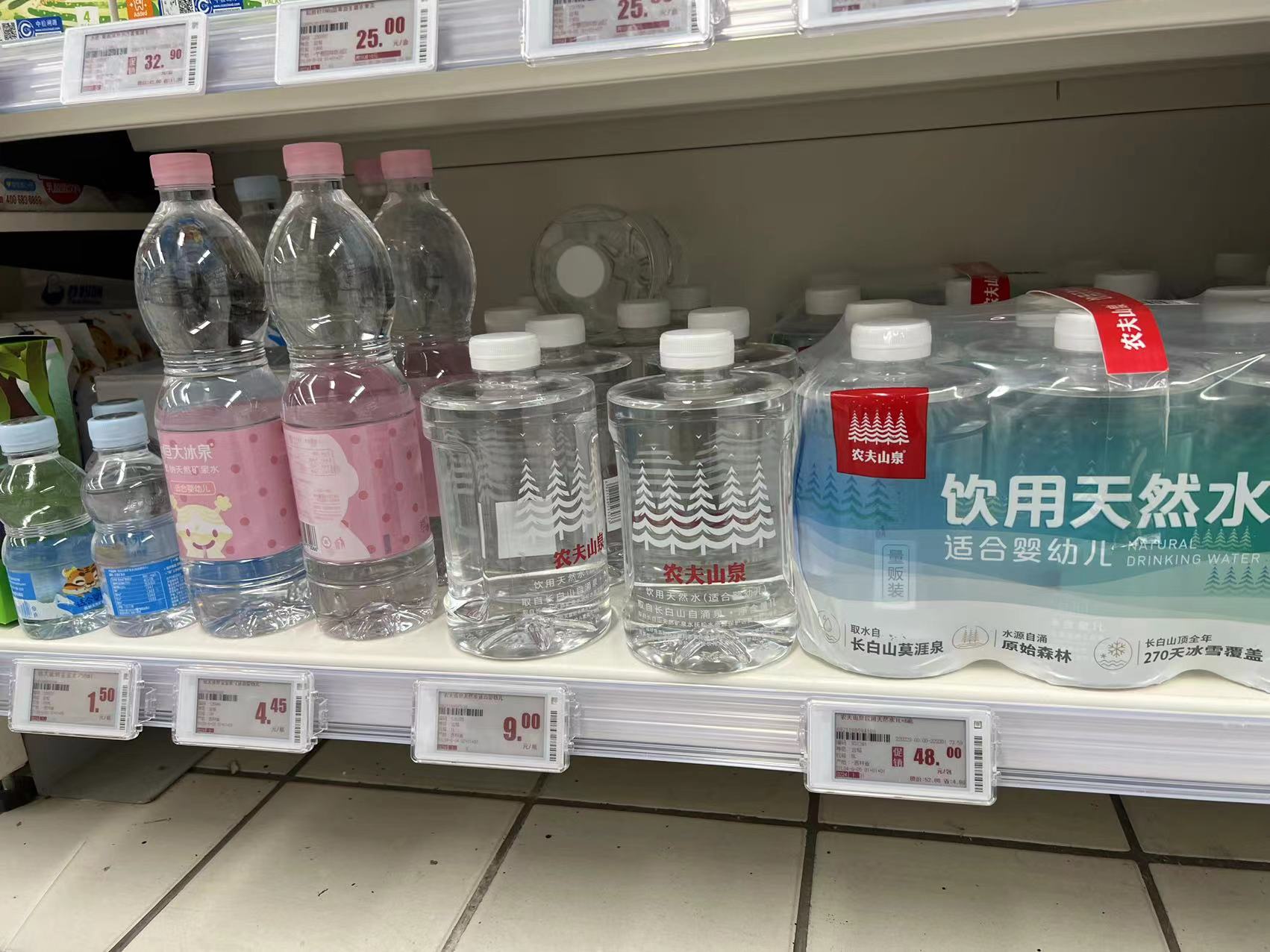
Packaged drinking water for infants sold on supermarket shelves. Sun Yanming/photo
According to the survey data, from 2015 to 2019, the demand for maternal and child water in China increased from 8.9 million bottles to 52.2 million bottles, with a compound annual growth rate of about 55.6%; The maternal and child water market has reached 240 million yuan, but it accounts for a very small proportion in the global market. Weng Yongsong said that there are still few consumers of packaged drinking water for infants in China, and only nearly 50 water companies have relevant production qualifications.
The data of the seventh national census shows that China is 0-mdash; The total number of 3-year-old infants is 70 million, 0-mdash; The number of 6-year-old infants is 180 million, and the number of new births reaches 1750&mdash every year; Between 19.5 million. According to the latest data released by the National Bureau of Statistics, in 2021, the birth population in China was 10.62 million. China’s huge infant population base has laid a solid customer base for the infant packaged drinking water market.
"At present, maternal and child water has been basically popularized in developed countries in Europe and America, but it is still in the primary stage of public cognition in China." Le Fenpeng said that in recent years, China’s maternal and child water market has developed strongly. In the future, with the improvement of public awareness, the market has great development potential.
Tip: You should look at key indicators when purchasing.
How do consumers choose packaged drinking water that meets the physiological characteristics of infants? In this regard, Li Fuxing said that consumers should carefully read the product labels, mainly focusing on key indicators, including sodium ions less than 20mg/L and total dissolved solids at 30-mdash; 100mg/L, pH 7-mdash; Between eight. In addition, it depends on the water source, and it is best to make a comprehensive and systematic scientific evaluation of the water source on the basis of general testing.
At present, there are a few illegal enterprises in the infant drinking water market that produce fake and shoddy products at will. For example, some packaged infant drinking water is made by adding baking soda tablets to pure water, and the sodium ion reaches more than 100 mg/L.
Le Fenpeng suggested that when consumers choose packaged drinking water for infants and young children, they should preferably obtain brands that meet the standard test report and certification of packaged drinking water for infants and young children, and boil the packaged drinking water for infants and young children before drinking it. It is not recommended to choose pure water because it contains almost no mineral elements.