The Academic Advisory Committee of China Institute of History was established, with Dai Yi, an expert in Qing history, as the director.

The China Institute of History of China Academy of Social Sciences, which was officially unveiled in January this year, has now set up an academic advisory committee, and 41 committee members from the national history circle have officially made public appearances.

In the 19th edition of People’s Daily published on September 24th, it was announced that "according to the establishment plan approved by the central authorities, the China Institute of History selected 41 experts and scholars from the national history circle to set up an academic advisory committee. Members of the Academic Advisory Committee of China Institute of History are now announced. "

According to the announcement, the director of the Academic Advisory Committee of China Institute of History is Dai Yi, director of the National Compilation Committee of Qing History and a first-class post professor at Renmin University of China.

According to public information, Dai Yi, male, born in September, 1926, is a native of Changshu, Jiangsu Province. His academic expertise is the modern history of China and the history of Qing Dynasty, and his representative works include Modern History of China. At present, Dai Yi is honorary director of the Institute of Qing History of China Renmin University, librarian of central research institute of culture and history, and curator of Beijing Literature and History Research Museum.

Dai Yi was admitted to Shanghai Jiaotong University in 1944. Two years later, he dropped out and transferred to Peking University History Department, where he studied under Hu Shi, Zheng Tianting, Zhu Guangqian, Xu Deheng, Xiang Da and Deng Guangming. In 1948, under the arrangement of the Party organization, Dai Yi left Peking University for the Liberated Area, entered North China University in the Liberated Area, and then stayed there to teach, initially engaged in the study of China’s revolutionary history and modern history.

In 1955, Dai Yi was promoted to associate professor, served as the academic secretary of Wu Yuzhang, then president of China Renmin University, and later served as the editorial board of China History Series edited by Wu Han. During the Cultural Revolution, Dai Yi was shocked and sent to Jiangxi’s May 7th cadre school for labor reform, and returned to Beijing in 1972.

Dai Yi devoted his life to the compilation of Qing history. In 1978, with the approval of the Ministry of Education, the Qing History Research Institute was formally established on the basis of the former Qing History Research Group. Dai Yi was in charge of the practical work, and for the purpose of compiling the Qing history, the academic research and personnel training of the Qing history were carried out in an all-round way. In 2002, the compilation plan of Qing history was approved by the state, and Dai Yi, who was over 70 years old, once again went into battle and became the director of the editorial board.

According to official website of Renmin University of China, "In the past ten years, under the overall framework of compiling the history of the Qing Dynasty as the main body and sorting out the documents and archives of the Qing Dynasty as the two wings, not only the main project of the history of the Qing Dynasty has been carried out smoothly, but also billions of words of archives and documents have been sorted out, and efforts have been made to save these cultural relics."

The Academic Advisory Committee of China Institute of History also set up two deputy directors, namely Jin Chongji, an expert on the history of the Communist Party of China and the modern history of China, and Wang Wei, an archaeologist.

According to the official resume, Jin Chongji, male, born in December 1930, Shanghainese, former executive deputy director and researcher of the Central Committee of the Communist Party of China Literature Research Office, whose academic expertise is the history of the Communist Party of China and the modern history of China, and his representative works include The Outline of China in the Twentieth Century. Wang Wei, male, born in May, 1954, is an adult in Shandong Province. He is a member of the Chinese Academy of Social Sciences, director of the Department of History, and a researcher at the Institute of Archaeology, China Institute of History. His academic expertise is in the study of the origin of Chinese civilization, archaeology from prehistoric times to Xia, Shang and Zhou dynasties, and archaeological research on ancient cultural exchanges in East Asia. His representative works include "Seeing the evil Matai country and the Japanese regime from China".

The remaining 38 members of the Academic Advisory Committee of China Institute of History announced in the announcement are:

Pei yu, male, born in May 1944, is from Fushan, Shandong. Researcher, Institute of World History, China Institute of History. Academic expertise is historical theory and history of historiography. His representative works include The History of Marxist Historiography (Editor-in-Chief).

Ma Min, male, born in June 1955, is from Fushun, Sichuan. Director and Professor, China Institute of Modern History, Huazhong Normal University. Academic expertise is the economic and social history of China, the history of exposition and the history of cultural exchange between China and the West. His representative works include between officials and businessmen: modern gentry and businessmen in social upheaval.

Ma Dazheng, male, born in August 1938, is from Shanghai. Researcher, China Frontier Research Institute, China Institute of History. His academic expertise is the history of China territory. His representative works include A Brief History of China’s Frontier (Editor-in-Chief) and so on.

Wang Xianming, male, born in February 1957, is from Changzhi, Shanxi. Professor, School of History, Nankai University. Academic expertise is the modern history and social history of China. His representative works include squire in the changing times-squire and the change of rural social structure (1901-1945) and so on.

Deng Xiaonan, female, born in June 1950, is from Linyi, Shandong. Professor, History Department, Peking University. Academic expertise is the history of Song Dynasty and the history of bureaucracy. Representative works include "The Law of Ancestors-A Brief Introduction to Politics in the Early Northern Song Dynasty" and so on.

Shi Jinbo, male, born in March 1940, is from Gaobeidian, Hebei. Member of Chinese Academy of Social Sciences, director of Xixia Cultural Research Center of China Academy of Social Sciences, and researcher of Institute of Ethnology and Anthropology of China Academy of Social Sciences. His academic expertise is China’s ethnic history, Xixia literature and history, and China’s ancient ethnic literature. His representative works include Research on Xixia Economic Documents, etc.

Feng Shi, male, born in October 1958, is from Beijing. Member of Chinese Academy of Social Sciences, researcher of Archaeology Institute of China Institute of History. Academic expertise is ancient philology, astronomy and archaeology, pre-Qin history, historical philology, and the history of ancient thought. His representative works include Astronomy and Archaeology in China.

Liu Beicheng, male, born in August 1949, is from Beijing. Professor, History Department, Tsinghua University. Academic expertise is modern world history, western thought history and historical theory. Representative works include "Portrait of Foucault’s Thought" and so on.

Liu Qingzhu, male, born in August 1943, is from Nanle, Henan. Member of Chinese Academy of Social Sciences, researcher of Archaeology Institute of China Institute of History. His academic expertise includes archaeology of ancient capitals in China, archaeology of ancient imperial tombs and archaeology of Han and Tang Dynasties. Representative works include "The Ancient Capital Asked" and so on.

Li Jie, male, born in November 1954, is from Kunming, Yunnan. Researcher, Development Research Institute, Yunnan University. Academic expertise is historical theory. His representative works include Research on Early Marxist Historical Thought.

Li Jie, male, born in February 1955, is from Pingyin, Shandong. Former president and researcher of Qiushi magazine. His academic expertise includes the history of the Communist Party of China, the history of People’s Republic of China (PRC), Mao Zedong’s life and thoughts, Socialism with Chinese characteristics’s theoretical system and the China of Marxism. His representative works include Mao Zedong’s Historical Contribution to New China.

Li Boqian, male, born in February 1937, is from Zhengzhou, Henan. Professor, Peking University Institute of Archaeology and Culture. Academic expertise is archaeology in China. His representative works include The Origin of Civilization and Collection of Three Generations of Archaeology.

Yang Gongle, male, born in April 1962, is from Zhuji, Zhejiang. Dean and Professor, School of History, Beijing Normal University. Academic expertise is the comparison of Chinese and foreign ancient history, ancient Roman history, etc. His representative works include A Probe into the Early Silk Road and so on.

Yang Guozhen, male, born in March 1940, is from Longyan, Fujian. Professor, History Department, Xiamen University. Academic expertise is social and economic history and marine history of China. His representative works include Research on Land Contract Documents in Ming and Qing Dynasties.

Wu Enyuan, male, born in April 1948, is from Chongqing. Researcher, Russian Institute of Eastern Europe and Central Asia, China Academy of Social Sciences. Academic expertise is world history, Russian history and the history of international communist movement. His representative works include The History of the Soviet Union.

He Yimin, male, was born in June 1953 in Chengdu, Sichuan. Professor, School of History and Culture, Sichuan University. His academic expertise includes China city history, China modern history and regional cultural history. His representative works include General History of China City.

Sha Jiansun, male, born in February 1934, is from Yixing, Jiangsu. Former deputy director and professor of the Party History Research Office of the CPC Central Committee. His academic expertise is the history of the Communist Party of China and the modern history of China. His representative works include The Historical Road of China in the Twentieth Century —— Comments on Some Social Thoughts, etc.

Zhang Shujun, male, born in October 1957, is from Laiwu, Shandong. Former member (deputy minister level) and researcher of the Central Committee of the Communist Party of China Institute of Party History and Literature. Academic expertise is the history of the Communist Party of China. His representative works include The Great Turning Point-A Record of the Third Plenary Session of the Eleventh Central Committee of the Communist Party of China.

Zhang Haipeng, male, born in May 1939, is from Hanchuan, Hubei. Member of Chinese Academy of Social Sciences, researcher of Institute of Modern History, China Institute of History. Academic expertise is the modern history of China. His representative works include A Concise Reader of Modern History of China (co-author).

Chen Qingying, male, born in October 1941, is from Taishan, Guangdong. Researcher, China Tibetology Research Center. Academic expertise is Tibetan history books. His representative works include Eight Sibas, the Imperial Teacher of Yuan Dynasty, etc.

Chen Zuwu, male, born in October 1943, is from Guiyang, Guizhou. Member of the Chinese Academy of Social Sciences, researcher of the Institute of Ancient History, China Institute of History. Academic expertise is the ancient academic history of China. His representative works include History of Learning Cases in China.

Chen Jin, male, born in October 1958, is from Jianyang, Sichuan. Former member (deputy minister level) and researcher of the Central Committee of the Communist Party of China Institute of Party History and Literature. His academic expertise is Mao Zedong and the history of the CPC. His representative works include Mao Zedong’s Cultural Character and so on.

Chen Qianping, male, born in February 1955, is from Yangzhou, Jiangsu. Chairman and Professor, Academic Committee, Research Center for the History of the Republic of China, Nanjing University. Academic expertise is the history of the Republic of China. Representative works include "Negotiations between China, Britain and Xizang before and after the Anti-Japanese War (1935-1947)" and so on.

Miao Pusheng, male, born in November 1948, is from chiping, Shandong. Researcher, Academy of Social Sciences, Xinjiang Uygur Autonomous Region. Academic expertise is national history and local history of Xinjiang. Representative works include Outline of Xinjiang History (co-editor) and so on.

Lin Wenxun, male, born in March 1966, is from Qujing, Yunnan. Party secretary and professor of Yunnan University. Academic expertise includes Chinese economic history, China rural social history and Chinese frontier studies. His representative works include Outline of Social Change in Tang and Song Dynasties.

Zhou Weizhou, male, born in February 1940, Kaiping, Guangdong. Professor, China Western Frontier Research Institute, Shaanxi Normal University. His academic expertise is the national history of China. His representative works include "A Study of Ethnic Relations in the Middle Northwest of China" and so on.

Zheng Shiqu, male, born in August 1946, is from Fuzhou, Fujian. Professor, School of History, Beijing Normal University. Academic expertise is China’s modern history, modern ideological and cultural history. His representative works include "A Study on the Cultural Thought of the quintessence School in the Late Qing Dynasty" and so on.

Hu Dekun, male, born in March 1946, is from Suizhou, Hubei. Chairman, chief expert and professor of China Institute of Border and Ocean Studies, Wuhan University. Academic expertise is the history of World War II, the history of borders and oceans. His representative works include China and World Studies during the World Anti-Fascist War (Editor-in-Chief).

Hou Jianxin, male, born in Tianjin in October 1950. Deputy Director of Academic Committee of Tianjin Normal University, Dean and Professor of European Civilization Research Institute. Academic expertise is world history. His representative works include Western Europe and China in the Period of Social Transformation.

Geng Yunzhi, male, born in December 1938, is from Haicheng, Liaoning. Member of Chinese Academy of Social Sciences, researcher of Institute of Modern History, China Institute of History. His academic expertise is in the history of modern thought, culture and politics in China. His representative works include Introduction to the Study of Cultural Transformation in Modern China: Cultural Transformation and so on.

Xu Lan, female, born in November 1947, is from Beijing. Director and Professor, Center for International Relations Studies, School of History, Capital Normal University. Academic expertise is world history, modern world history and the history of international relations. His representative works include Britain and the Sino-Japanese War (1931-1941).

Gao Xing, male, born in February 1962, is from Kuandian Manchu Autonomous County, Liaoning Province. Director and researcher of Zhoukoudian International Paleoanthropology Research Center of China Academy of Sciences, and director of Paleolithic Professional Committee of China Archaeological Society. Academic expertise is prehistoric archaeology, human origin and evolution. His representative works include Shuidonggou: Archaeological Excavation and Research Report from 2003 to 2007, etc.

Ge Jianxiong, male, born in December 1945, is from Shaoxing, Zhejiang. Professor, China Institute of Historical Geography, Fudan University. Academic expertise is historical geography, population history, immigration history and cultural history. His representative works include History of Chinese Immigrants (editor-in-chief, author of the first and second volumes).

Jiao Nanfeng, male, born in January 1954, is from Yijun, Shaanxi. Researcher, Shaanxi Institute of Archaeology. His academic expertise is archaeology in Qin and Han Dynasties and the study of the ancient mausoleum system in China. His representative works include The Mausoleum of Emperor Han Jingdi and so on.

Xiong Yuezhi, male, born in December 1949, is from Huaiyin, Jiangsu. Researcher, Shanghai Academy of Social Sciences. Academic expertise is the modern history of China. His representative works include "The Spread of Western Learning to the East and the Society in the Late Qing Dynasty".

Wei Jian, male, born in December 1955, is from Hohhot, Inner Mongolia. Professor and Director of Northern Institute of Ethnic Archaeology, Renmin University of China. Academic expertise for the northern ethnic archaeology, Mongolian archaeology. His representative works include On the Capital of the Yuan Dynasty.

Wei Cuncheng, male, born in October 1945, is from Pingxiang, Hebei. Professor, School of Archaeology, Jilin University. His academic expertise is Koguryo’s archaeology and history in Bohai Sea, and archaeology in the Three Kingdoms, Jin, Southern and Northern Dynasties, Sui and Tang Dynasties. His representative works include Archaeology of Bohai Sea.

Qu Lindong, male, born in December 1937, is from Feidong, Anhui. Professor, School of History, Beijing Normal University. Academic expertise is historical theory and the history of Chinese historiography. His representative works include Collected Works of Qu Lindong.
Scholars’ rural research | How to hand over rural environmental governance to the market

[Editor’s note]

In the period when the major strategy of rural revitalization is fully implemented, field research on rural areas is particularly important.

What kind of perspective will scholars returning to the countryside in the Spring Festival observe their familiar countryside? The report column of The Paper think tank published a group of "scholars’ rural investigation reports", inviting scholars to observe and explore the effective path of rural revitalization from many different dimensions, such as rural governance, villagers’ employment, rural industrial status, rural pension, rural education and rural marriage and love market, hoping to provide valuable reference for rural revitalization.

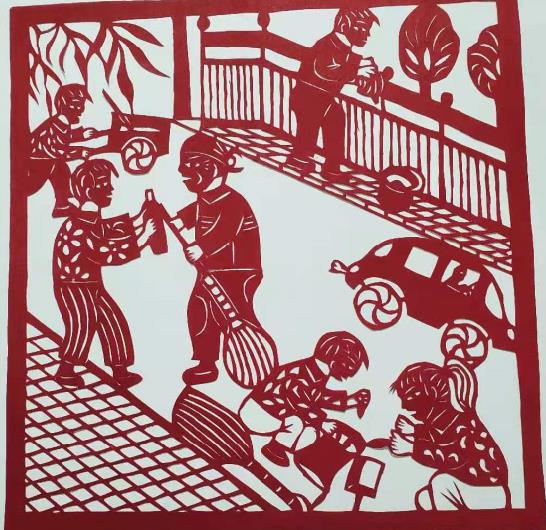
Paper-cut pictures are provided by Zhongyang Wuxiaofen Paper-cut Studio.

At present, while the urban environment is improving day by day, rural environmental problems are becoming more and more prominent, such as "garbage surrounding villages", rural water environmental pollution, and all kinds of wastes "going to the countryside", which are still far from the people’s desire for a better life and building a well-off society in an all-round way. Rural environmental pollution is a prominent shortcoming that restricts rural revitalization.

The comprehensive improvement of rural human settlements is closely related to the production and life of hundreds of millions of farmers, and it is one of the yardsticks to reflect the progress of civilization. Recently, the author went to Zhejiang, Jiangxi and other places for field research, and found that from the reality, various places have successively carried out a series of practical explorations, such as improving the appearance of villages, improving rural human settlements and building beautiful countryside, and achieved certain results. But on the whole, rural environmental governance is still dominated by the government, lacking a long-term market-oriented mechanism.

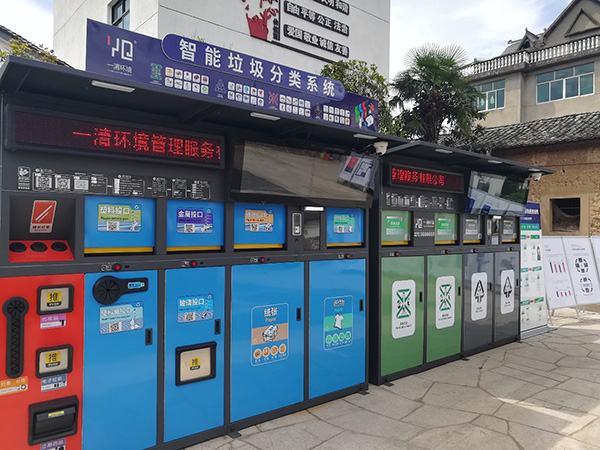
Quzhou intelligent garbage sorting system. Photo courtesy of the author

Investigation on the current situation: rural environmental governance is dominated by the government and lacks market-oriented means.

In recent years, with the rapid economic development, the problem of rural ecological environment pollution has become increasingly prominent. Research shows that the per capita output of domestic garbage in rural areas is about 0.8 kg per day. What’s more, for a long time, due to the lack of specialized personnel and funds in rural areas, many rural garbage disposal work in China has been blank. Judging from the 588,000 administrative villages in China, only 218,000 have effectively treated domestic garbage, accounting for only one third of the country. The situation of "garbage surrounding villages" is grim. Judging from the situation of water pollution in rural areas, the domestic sewage in rural areas in China exceeds 8 billion tons every year, but the sewage treatment rate is less than 10%. The vast majority of rural sewage is directly discharged into rivers and farmland, which affects crop production and agricultural product quality.

Strengthening the comprehensive improvement of rural environment has become a major issue to be solved urgently in the process of promoting rural revitalization in various places. Through on-the-spot investigation, the author found that the current comprehensive management of rural environment mainly faces the following three problems to be solved urgently:

(A) infrastructure debt, investment.For a long time, China’s rural infrastructure is weak and there are many historical debts, which require a lot of money. Although the country has invested a lot of money in new rural construction and rural revitalization in recent years, after all, there are more than 480,000 towns and 690,000 villages in China, and the conditions in many mountainous villages are very bad, and the amount of funds needed for infrastructure construction is huge.

(2) Social capital investment is high and the return is low.The comprehensive management of rural environment has high social capital investment, low market return rate and poor profitability of enterprises, which leads to poor enthusiasm for social capital investment. Many rural environmental governance needs a large amount of funds, and financing loans are difficult, which can not produce intuitive economic benefits quickly. For enterprises, it is a project with low return on investment and poor profitability.

(3) There are great differences in technology and it is difficult to copy.Compared with urban environmental governance, there are differences between rural pollutants and urban environmental governance in composition, technology and technology, which cannot be completely replicated. Taking sewage treatment as an example, the composition and content of pollutants in rural sewage and urban sewage are different, so the investment in urban sewage treatment construction and market-oriented operation mode of enterprises cannot be universal.

Empirical case: give play to the role of marketization and work together to solve rural environmental problems

(A win-win situation between government and enterprises to create "Qujiang experience"

For rural areas, the task of garbage sorting is arduous and difficult to last. In the past, township and village cadres independently managed the garbage sorting work, and it was inevitable that cadres would press the gourd to float the ladle. Qujiang District, Quzhou City, Zhejiang Province, implements the rural "garbage revolution" and implements the third-party service of garbage classification according to the enterprise operation mode, which can make town and village cadres change from "in front of the stage" to "behind the scenes" and from "athletes" to "referees", effectively grasp the "tangible hand" of the government and the "public hand", form a benign interaction mechanism with the public and third-party enterprises, and ensure the durability and effectiveness of government supervision manpower.

Third-party operation and maintenance integrates the market resources of the industry, and the practice has formed a hierarchical structure and overall law of early source classification and reduction, medium-term recycling of renewable resources, and late landfill and incineration treatment and gradual reduction, clarifying the access of each link of garbage disposal, reducing the burden on township and village cadres, bringing profits to enterprises, giving villagers paid feedback, and reducing environmental pressure, thus forming a win-win situation for all parties.

After the third-party operation and maintenance, 14 towns (streets) in Qujiang District are managed by one company as a whole, which can put an end to the malpractice of caring management. According to the requirements of enterprise personnel management, the original team of cleaning staff is screened out, people with good performance and good health are retained, older and lazy people are dismissed, new people who meet the post requirements are recruited, and a skilled, literate, obedient and dedicated cleaning team is reorganized, so as to dig deeper into cleaning staff. The "cleaning grid" and "general grid" will complement each other and promote each other, and we will fully promote the "1+5" classified cleaning mode of cleaning+classification, cleaning+sorting, cleaning+recycling, cleaning+publicity and cleaning+inspection, which will inject a steady stream of new power into grassroots governance. Up to now, there are 1,432 cleaning teams in Qujiang, and 56 cleaning grids are divided, with an average of 26 cleaning staff in each cleaning grid. In addition, 14 film lengths and 56 squad leaders are equipped to implement the "three-fixed" grid management of personnel, posts and responsibilities to ensure that the responsibilities are assigned to people.

(B) cadres and masses to jointly promote the "toilet revolution."

Small things in rural areas are connected with people’s livelihood. It is not easy to do these "small projects", such as changing toilets in rural areas, treating rural garbage and sewage, and improving the appearance of villages. Who will do it, how to do it and how to run it?

The author learned from the investigation in Changshan County, Zhejiang Province that the government of Changshan County attached great importance to the "toilet revolution" in rural areas, and in April 2017, it took the lead in innovating and launching the director system of public toilets in the country, thus setting off a "toilet revolution" throughout the county. Ye Meifeng, secretary of the county party committee, is the general director of public toilets in the county, while the deputy secretary of the county party committee and the deputy county magistrate are the general directors of public toilets in rural areas and urban areas respectively. In urban areas, the directors of public toilets are the cadres of the county housing and construction bureau and the secretary of the street party working committee, while in rural areas, they are divided into the secretary of the township party committee and the village committees. Every public toilet in the county has its own strengths, and efforts are made to solve the problems of low-grade public toilets, old facilities, poor hygiene and inadequate management, and comprehensively carry out the "300 Action" to reform

"Don’t look at our village, where the village roads are washed, the ancient trees are green, the courtyards and toilets are clean and tidy. A few years ago, there were weeds, piles of garbage, dirty toilets and mosquitoes flying all over the sky." Ye Jiqiang, secretary of the branch of Xucun Village, said with deep feelings. In recent years, Xu Cun put forward the brand of "Dream-chasing Party Branch", which has changed from a weak village with prominent sectarian contradictions, difficult to unify the masses’ thoughts and backward work in various centers to a famous "Golden Nail Village" in the county.

(C) not to rely on solving the "garbage around the village"

Rural environmental governance cannot be separated from capital investment, but it does not mean that money is a necessary condition for rural environmental governance. In other words, "the more money the state invests, the better the rural environment will be" is a misunderstanding. Here, the author takes a field survey of a village in Jiangxi Province to build a garbage pool as a case to explain.

Since 2016, in an F village in Jiangxi Province, villagers have begun to feel the great troubles caused by garbage surrounding villages, and environmental problems have become a major headache for villagers. Someone in the village suggested building a garbage disposal pool, and the village head naturally agreed, but the key question came-where did the money come from? The village has applied to the superior several times, and the result is "no money", and the village has thousands of dollars on its books. Some people suggest that you should stop expecting your superiors to allocate money and build it yourself. But the problem comes again. It is not easy to mobilize the whole village to raise funds in rural areas. There are nail households and poor households in the village, and the conditions of each family are different. The final result of "waiting, relying and wanting" is that the construction of garbage pools is delayed again and again. Later, several young people who worked outside the home couldn’t sit still when they went home during the Spring Festival. They went to the village head to discuss it, stopped "waiting, relying and wanting" and organized the villagers to build it themselves. The final plan is: in terms of mobilization, the village head and several young people who are working hard outside are responsible; In terms of funds, part of the village collective, part of the young people, and part of the villagers voluntarily raise funds, and those who do not contribute to work and contribute; In terms of work, each family has at least one job, which can be flexibly discussed according to the amount of capital contribution; In terms of purchasing materials, young people are responsible. Finally, all the families at home in the village have at least one job, a total of 70 jobs; The cost of materials, such as cement, stone, sand, bricks and tiles, pipes, etc., totaled 7,500 yuan, and the final cost of the village was less than 10,000 yuan. At the same time, the follow-up garbage pool cleaning was carried out in a long-term way of "village collective contribution+township donation+villagers’ work".It is estimated in the village that it is reasonable to spend more than 30,000 yuan if the garbage disposal pool is funded by the government.

The above cases show that "having money to do things well" does not mean "having no money to do things". Rural environmental governance needs to establish a diversified fund-raising mechanism, but it needs to open up ideas, explore and innovate, give play to people’s subjective initiative, and use limited funds on the cutting edge. From the perspective of fund raising, try to raise more funds for rural environmental governance. But more crucially, it is not entirely driven by money. We should use our brains and market-oriented operation ideas to guide rural environmental governance to a more long-term sustainable development path through the instigation of capital investment.

Countermeasures and suggestions: establish a market-oriented long-term mechanism for rural environmental governance

(A) "Government" and "market" make concerted efforts to control the rural environment.

The difficulty of rural environmental governance lies in "market failure". "Market failure" and "government failure" are the reasons for rural environmental pollution and low governance efficiency. Therefore, we should adopt the method of economic analysis to study and put forward the countermeasures of combining government and market, and "government" and "market" should work together. For the vast rural areas, it is difficult to manage the rural water environment only by a large amount of government investment. From the perspective of multi-center governance, it is proposed that the market can play a positive role in effectively allocating resources in rural non-point source pollution control.

Based on the fact that rural environmental pollution is different from the characteristics of cities, and the rural environment has the characteristics of small but many pollution sources and wide and scattered pollution sources, we can give full play to the vast rural land space, natural degradation and digestion capacity and appropriate environmental carrying capacity, adopt ways suitable for rural environmental governance, such as returning compost to fields, natural digestion and small ecological wetlands, compare and analyze the governance model with the government as the main body and the autonomy model with villagers as the main body, and put forward effective ways of rural environmental governance combining government with market.

(2) Explore the market-oriented mode of "market packaging" for river regulation.

For the water environment management of rural rivers, we can adopt the common operation mechanism of rural river regulation and market-oriented mode. The government can realize the long-term market-oriented management of rural river regulation by establishing the modes of "raising rivers by rivers", "raising rivers by dikes" and "raising rivers by ponds".

The government contracts the river and coastal public land to individuals or enterprises through inviting tenders, and the government signs contracts with the contractors. The river contractors need to fulfill the obligations of daily work such as river dredging and cleaning, and take the initiative to accept government inspections and supervision complaints from the masses. At the same time, the river contractor can obtain the corresponding rights, that is, the right to use the land on both sides of the river, from which the contractor can obtain economic benefits in other ways.

(C) the introduction of PPP model to manage the rural environment with diversified and integrated thinking

By introducing PPP model to rural environmental governance, we should fully consider the relevance between rural environmental governance projects and other rural related industrial projects. From the perspective of industrial integration, we should jump out of the simple "financing thinking" and adopt "packaging strategy" to promote diversified governance through system construction, and promote professional and market-oriented operation through improving price mechanism and preferential policies. Market-oriented operation and enterprise management play a role in the comprehensive improvement of rural environment, and the third-party property company can play the leading role through the government’s purchase of services, which can explore the market-oriented path of rural environmental improvement in the construction of new countryside.

(The author Jiao Xudong is a Ph.D. student in the Research Center for Cleaner Production and Circular Economy of china environmental science Research Institute, mainly engaged in theoretical and policy consultation and research on circular economy, environmental governance, rural revitalization, county green development, etc. As the main author, he participated in the drafting of the State Council’s major policy documents such as the Opinions of the General Office of the State Council on Establishing a Complete and Advanced Recycling System for Waste Commodities, and participated in the research and formulation of the national policy of "exchanging old appliances for new ones" all the time. )

Looking forward to the co-production trend of Chinese films in cross-strait and three places after the end of Golden Horse


Cross-strait cooperation has won favorable comments
 

  The 48th Golden Horse Award has just concluded. Among the five works nominated for best film, except the relatively pure Taiwan Province films, the main producers of the other four films are all from the mainland, and most of the films nominated for other awards are also from Beijing, which is unprecedented in the Golden Horse Award in recent years. Regardless of whether "seediq bale" won the best film for the time being to praise local films, it can be seen from this nomination list that apart from the integration of mainland and Hong Kong films, the integration of Taiwan Province, Hong Kong, the mainland and the three places across the Taiwan Straits has become a general trend.

Seven cross-strait co-productions a year usher in a new era.

  Xu Anhua won three weighty awards: Best Actor, Best Actress and Best Director. The three producers of this film, Bona Film Entertainment Co., Ltd., are from the mainland, Yingyi Entertainment Co., Ltd. is from Hong Kong, and Yindu Institution Co., Ltd. is a film company with a more mainland background although it is nominally from Hong Kong. In recent years, the film industry of Hong Kong and the Mainland has cooperated in an all-round way, and a large number of Hong Kong filmmakers have moved northward, which has jointly promoted the rapid development of the Chinese film market with mainland filmmakers, and this co-production craze has now begun to affect Taiwan Province.

  The Taipei Film Committee mainly assists domestic and foreign film workers in Taiwan Province in landscape survey, venue application, financing, production and marketing … … After the signing of ECFA (Framework Agreement on Cross-Strait Economic Cooperation), there are more and more co-productions between the mainland and Taiwan Province. Rao Zijuan, director of the Taipei Film Committee, told Sina Entertainment that in 2011, two co-produced films, Starry Sky, were released in the mainland and Taiwan Province, and in 2012, there will be about seven co-produced films from Taiwan Province in the mainland to meet the audience, including LOVE directed by Doze Niu, starring Ehan Juan, Mark Chao and Zhao Wei, supervised by Li-Kong Hsu, and Eating Men and Women 2: Good Near and Good Far, starring Lan Zhenglong and Huo Siyan. There are so many co-productions, which can’t be compared with previous years.

Small fresh with large complementary environmental resources is the root of development.

  Netizen Don He believes that from the award results of this Golden Horse Award, Taiwan Province is actually supporting local films as a big Chinese-speaking circle. Rao Zijuan, director of the Taipei Film Committee, believes that this is actually the inevitable way out after the development of Taiwan Province film. There is no special film school in Taiwan Province, but only the film departments of various universities, and many talents have to go overseas for further study, which has caused the film professionals, including directors, to often have a broken file. Rao Zijuan recalled that when he returned to Taiwan Province and worked in "Taiwan Province China Film Co., Ltd.", the company could not find any staff proficient in English to help foreign directors see the scenery. In addition to sufficient funds and a huge audience, the mainland has more film resources, which can provide necessary training for new directors. Moreover, co-production can break through the limitation of projection quota, which provides rich soil for the development of co-production. Rao Zijuan said, "Taiwan Province people like to talk about ideas, while mainlanders like to tell stories. Compared with the mainland, Taiwan Province’s culture is more detailed, filmmakers pay more attention to details, and the two sides complement each other, which can improve the quality of the film. "

  In addition, the younger generation of directors in Taiwan Province now seem to have a more sense of mission. Some directors have made movies that sell well at the box office, but they can still go to other crews as deputy directors. They have a very close relationship. Director Jia Zhangke (Weibo) once gave a concise description of the relationship between mainland directors in Weibo. "Everyone looks down on each other." The ecological gap between the two places can be seen.

  Rao Zijuan said, perhaps it is because Taiwan Province films have been waiting too long for a "renaissance", and directors like to discuss some profound topics. Nowadays, Taiwan Province seems to be less like a Chinese film made solely for entertainment.

Give up the quota system and impress the audience on both sides of the strait with "love"

  Although there are more and more co-productions, it is now stipulated in Taiwan Province that only ten mainland films can be shown in a year. Interestingly, there is no quota limit for films in other regions. In mainland China, Taiwan Province films are imported, and the quota is pitiful. In recent years, only a few works have been shown to mainland audiences. It is understood that on December 9th, Eddie Peng Yuyan, who won the Golden Horse Award for Best Original Song, will be released in the Mainland on December 9th. According to informed sources, the box office miracles in Taiwan Province and Hongkong will also be released in the Mainland in January next year.

  In addition, more and more filmmakers also call for breaking the quota restrictions, introducing more excellent films and strengthening cultural exchanges between the two sides, which requires the efforts of both sides.

  Peggy Chiao, the godmother of Taiwan Province film New Wave, a famous scholar and producer, once said that although there is only a shallow strait between the mainland and Taiwan Province, the cultural gap is actually very deep. Rao Zijuan, director of the Taipei Film Committee, also said that at present, talking about love and humanity is still an excellent channel to break the "hard ice" of cross-strait culture. Xiaogang Feng’s made NT$ 30 million (about RMB 6.28 million), setting a record for the highest box office of mainland movies in Taiwan Province. "This film focuses on people after the natural disaster, and everything returns to people. This is a universal emotion."

Reasonable Marketing, Let Movies Boost Taiwan Province Tourism

  Of course, mastering "love" does not mean getting the secret of success, and the expression is equally important. Xiaogang Feng’s box office in Taiwan Province is very ordinary, and it has not received a strong response, while Jiang Wen’s box office in Taiwan Province is less than NT$ 1 million, although it has swept the mainland film market. Rao Zijuan believes that such problems are mainly due to the failure of marketing and cultural barriers.

  "We hope to promote cultural tourism between the mainland and Taiwan Province through Doze Niu’s LOVE, which will be released in the two places on Valentine’s Day next year." Rao Zijuan said, "Through this film, we can see the lives of ordinary Beijingers, which is what young people in Taiwan Province want to know. "If You Are the One" is also a love affair, but it is more like acting between two stars, Ge You and Shu Qi (Weibo). " Rao Zijuan also mentioned the drama "Treasure Island Village", which was widely welcomed in the mainland. This work about the culture of Taiwan Province’s family village has won unprecedented success, which shows that the cross-strait desire for cultural communication is still very strong.

  Rao Zijuan believes that most film distribution companies in Taiwan Province still don’t know how to market mainland films, which leads to many excellent films being buried. Taiwan Province films often encounter such problems in the Mainland. In this regard, the Tangshan Earthquake produced by Huayi did a good job. Before the film was released in Taiwan Province, the distributor found Xiaogang Feng, Chen Guofu and Hou Xiaoxian to hold a forum to create momentum for the film. In addition, China Times Publishing House also printed the highlights of the original film novel Aftershock into a booklet and sent it free of charge, which attracted the attention of a large number of intellectuals. In any case, attention to detail marketing can always win the hearts of the audience.

Promoting sustainable urban development: micro-transformation and renewal of old blocks

Embroidery efforts have been made in Xiaoxihu District, Nanjing, Jiangsu Province, and micro-renewal of old urban areas featuring "small scale, gradual progress and courtyard by courtyard" has been implemented.
Micro-renovation and renewal of old blocks

In October, 2022, the Supreme Leader of president sent a congratulatory letter to the 2022 World City Day Global Home Event and the Second Global Conference on Urban Sustainable Development, pointing out that the World City Day Global Home Event adheres to the concept of "Better City, Better Life" and is committed to promoting the sustainable development of global cities, which is of great significance to creating a development pattern of balanced benefits, coordination, tolerance, win-win cooperation and common prosperity.

World Cities Day is the first international day with the theme of cities established by the United Nations, and it is also the first international day initiated by the government of China and widely recognized and supported by the international community. In October this year, at the awarding ceremony of the Global Sustainable City Award (Shanghai Award) and the opening ceremony of the China home event of World City Day 2023, the Shanghai Handbook: A Guide to Urban Sustainable Development in the 21st Century, which was jointly compiled by Shanghai, UN-Habitat and the Bureau of International Exhibitions, was released, and some cases were selected, such as the micro-renovation of Xiaoxihu District in Nanjing, Jiangsu Province, the Community Development Fund in Chengdu, Sichuan Province, and the ecological vitality community in Wan Li Street in Putuo District, Shanghai.

How to slightly transform the old urban areas? How do community funds benefit people’s livelihood? How to add vitality to grassroots governance? Recently, reporters visited Nanjing, Chengdu and Shanghai on the spot.

In the morning, standing on the sunny roof terrace of bask in the quilt, Xu Qingyi looked down and saw the tall and strong loquat tree in the courtyard. "When my old house was rebuilt, the designer rebuilt the terrace according to our requirements and kept the loquat tree I planted when I was a child." As an old neighborhood in Nanjing Xiaoxihu area, 75-year-old Xu Qing praised the renovation here.

Xiaoxihu District, Confucius Temple Street, Qinhuai District, Nanjing, also known as Dayoufang Lane Historical Area, is one of the 22 historical areas identified in the Protection Plan of Nanjing Historical and Cultural City (2010-2020). For a long time in the past, it used to be a crowded and messy shanty town with inconvenient life. There were 810 households with more than 3,000 residents living within an area of less than 5 hectares.

In recent years, Nanjing has carried out a pilot project in Qinhuai District, which is characterized by "small-scale, gradual and courtyard-by-courtyard" micro-renewal of old urban areas. While retaining the memory of the city, it has comprehensively improved the living environment and injected new vitality into the old city. At present, the experience of the renovation of Xiaoxihu District has been popularized in 14 residential renewal projects in the old city of Nanjing.
How to deal with the relationship between protection and development in urban renewal? How to focus on the needs of the people? How to continue the urban context? The reporter went to the Xiaoxihu area to investigate.
Research first

Make it clear that "seeing things, people and life" in the transformation of the old city, and form a "five-party platform" to discuss and build together.

The sunshine spilled into the living room and fell on the body, which was warm. "Brand-new, warm and comfortable, full of happiness …" Xu Qing took the reporter to visit home and said a series of adjectives.

"In the past, the house was next to the house, and the lighting and ventilation in the room were not good, and the related facilities could not keep up." Xu Qing said that although he wants to improve his living conditions, the older he gets, the more difficult he feels about his old house. "I have lived for generations and have feelings."

In 2015, I heard that the relevant departments of Qinhuai District investigated the renovation of the old city in Xiaoxihu area. Xu Qing remembered the scene of all the aborigines moving when some old areas were renovated in the early years, and could not help but worry a little, "Will your old house be lost?"

There have been many explorations in Nanjing to carry out the renovation of the old city. Li Jianbo, director of Qinhuai Branch of Nanjing Planning and Natural Resources Bureau, said that Nanjing has taken the practice of demolishing the old and building a new one in the renewal of old urban areas, which has accelerated urban development and improved people’s livelihood needs, but it has affected the style of the old city to some extent. Efforts have also been made to protect the old city buildings, but commercial development has moved out of the aborigines and there is less fireworks.

"We constantly sum up practical experience and gradually realize that urban renewal and transformation should take into account urban construction and residents’ living needs, and handle the relationship between protection and development." Li Jianbo, who is also the executive deputy director of the Urban Renewal Office of Qinhuai District, said that in 2015, the former Nanjing Planning Bureau and other departments proposed to change "top-down expropriation" to "bottom-up renewal", and made clear the general principle of "seeing things, people and life" in the transformation of the old city, which provided guidance for the renovation of Xiaoxihu District.

How does the idea land? In July, 2015, Nanjing contacted experts and students from three local universities in architecture, planning and other related fields, and went deep into Xiaoxihu area to carry out investigation and research, exploring specific ideas for the renovation of old streets. After comprehensive evaluation, the scheme proposed by Han Dongqing, a professor from the School of Architecture of Southeast University, stood out.

"At that time, we refined the plan according to experts’ opinions, and established a’ five-party platform’ composed of government functional departments, planning and design teams, state-owned enterprise construction platforms, street communities and residents to promote urban renewal in the process of joint construction. Among them, Han Dongqing’s team is responsible for planning and design, and Nanjing Historic City Protection and Construction Group Co., Ltd. (hereinafter referred to as "Nanjing Libao Group") is implemented as a platform for state-owned enterprises. " Li Jianbo said.

Co-construction is inseparable from repeated consultations. "Since 2015, we have only spent four years in preliminary research and demonstration." Li Jianbo, who participated in the renovation of Xiaoxihu area all the way, said, "The first step is to solicit opinions from the masses, which made us feel difficult. For example, there are many property owners in many old houses, some want to move, some want to transform, and some family members still have different opinions on how to transform. "

In October 2017, Qinhuai District organized relevant departments to investigate in other places. The practical exploration of transforming residential courtyards one by one in local old streets and symbiosis between indigenous people and new formats helped them open their minds.

"We have changed the traditional practice of’ concentrating on a period of time and completing the renovation of the whole area at one time’ in the past. After fully listening to the opinions of relevant departments, we decided to adopt the idea of’ small-scale, gradual and courtyard-by-courtyard’ micro-renovation, and accordingly formulated the" Guiding Opinions on the Implementation and Management of the Micro-renovation Planning Scheme for the Historic Section of Xiaoxihu in the South of the Old City ". Li Jianbo said.

According to the guiding opinions, residents who are willing to renovate will be paid by the property owner and given some subsidies by the government, and the residents will discuss the renovation plan with the designers and builders of the "Five-Party Platform"; If you choose to find another house to move and give up the property rights of the old house, you will be compensated according to the policy; If the property rights are reserved and the old houses are leased to the state-owned enterprise to build a platform, the vacated space will be used for public facilities and the introduction of formats to promote the organic renewal of the old streets; If you have not made up your mind about whether to transform, you can wait until the conditions are ripe. "The working mechanism of the’ five-party platform’ has been retained, and planners are resident in the community and can come to the door at any time." Li Jianbo said.

Xu Qing chose the renovation, feeling that he saved money and worry. "During the renovation of the old house, the planners and builders visited many times to listen to opinions. Because my old house is a dangerous building, according to relevant policies, the government has borne 60% of the renovation costs. "

Li Caifeng, who lives in Xiaoxihu District, chose to rent. "The two-story building where my family lives was built in the late Qing Dynasty and the early Republic of China. I have lived here since I was a child." The 70-year-old Tong Nannan described his mother Li Caifeng’s treasure of the old house as "treating it as a treasure". "Whoever accidentally touches a wall will feel distressed."

In October, 2020, considering his advanced age and difficulty in housing renovation, Li Caifeng rented his old house to Nanjing Libao Group for repair and use, and rented a house in a nearby neighborhood with the rent to improve his life in his later years.

One household, one policy

Respect the wishes of residents, carry out refined transformation and optimize facilities.

"Construction started in March 2021, ended in August, and was renovated and moved home in December." Xu Qing still remembers the process of house renovation. "During the renovation, several days are the same, and sometimes we come to see it several times a day."

This 78-square-meter "new home" is full of ingenious design ideas: in order to preserve the old loquat tree, the designer built a patio in front of Xu Qing’s old house. Han Dongqing, who presided over the renovation design of Xu Qingjia’s old house, said: "We use the small space in front of the old house to build a patio centered on old trees, which is light and ventilated."

This ingenious design is more than one in Xu Qingjia’s house. There is only a narrow space more than 30 centimeters wide outside the bedroom. The eaves are carefully designed above to form a small patio, and the green plants are planted at random. A large glass window is installed directly from the eaves of the patio to the floor of the bedroom. People sitting by the bed seem to be in a garden, and the sunshine is comfortable and the landscape looks beautiful.

"The spacing between houses in Xiaoxihu area is very small. We have changed more than 10 drafts of this patio design." Han Dongqing said, "It is necessary to’ open the window to see the scenery’ and be beautiful and generous, and at the same time take into account the needs of residents for ventilation and lighting in their daily lives."

There are two details that make Xu Qing particularly satisfied: one is the small terrace on the second floor of the old house, and the other is the stairs leading to the small terrace.

According to the original plan, the second floor roof of Xu Qingjia retains the appearance style of the old house roof in this area, with a certain slope. However, after hearing Xu Qing’s suggestion that he wanted to have a place to enjoy the cool in summer and dry clothes in winter, the design team carried out the design of "changing the slope to the flat". Nowadays, the small terrace with a roof of 28 square meters is surrounded by guardrails, and tables, chairs and clothes racks are added in the middle, which is safe and practical.

The stairs leading to the small terrace are unique. "According to the layout of the house, the slope from the balcony entrance to the wall root is very steep. If the stairs are laid, each step is 40 cm high. It is neither convenient nor safe for us to go upstairs and downstairs." Xu Qingbian said that he took the reporter’s experience: after the transformation, each floor of the stairs alternately rises from left to right with the middle as the boundary. The height of the steps is more than 20 cm, and it is not tiring to go upstairs and not steep to go downstairs.

The careful design of "one household, one policy" can be seen everywhere in Xiaoxihu area: some houses are small in size, and the designer carefully creates an open kitchen with a foldable sofa bed, which integrates the functions of kitchen, living room and bedroom; Some residents want to increase storage space, and designers use the height of housing space to build storage cabinets; Some residents have raised the problem of poor lighting in houses, and designers have added more windows in a small space according to local conditions … "We have divided Xiaoxihu area into 15 units and 127 implementation courtyards, fully respecting residents’ opinions and carrying out refined transformation according to the principle of one household and one policy." Han Dongqing said.

After the transformation, the old house is repaired as old as before, and the bolts of doors and windows have been repaired according to the original appearance; The wooden stairs that have been damaged for a long time have not been demolished, but are protected by the tread structure of "glass+steel", which is safe and does not lose the sense of history … "I showed the photos after the transformation to my mother who is inconvenient to move. She even said that she did not expect the transformation to be so meticulous and so good." Tong Nannan said.

How about the fine renovation of residential houses and the construction of supporting facilities? Chen Hongrong, a resident of Xiaoxihu District, took the reporter to visit the "Microtube Gallery" near his home: in the space about 1.8 meters wide and 2.4 meters deep below the ground, there are six pipes in four categories, such as optical cable, tap water, building fire water supply and sewage. There are power pipes and rainwater pipes in the two side rooms, and gas pipes are laid along the wall on the ground. "In the past, the faucets were shared, the wires were pulled privately, the alleys were particularly narrow, and there were no fire-fighting facilities. Nowadays, all kinds of facilities are fully equipped, and gas and tap water are directly connected to the home. Our alley residents have lived a modern life. " Chen Hongrong said.

Activation and utilization

Calculate the people’s livelihood account, cultural account and economic account, explore the interaction between culture and economy, and promote the sustainable transformation.

Chen Hongrong set out from home and went to a construction enclosure in a nearby street. "This will be a bathhouse in the future." Chen Hongrong said that although he has bathroom facilities at home, the public bathhouse where he chats while taking a bath is a part of the life of many old Nanjing people, and it is also the fireworks in the old streets.

Revitalize the use of housing space vacated by some residents, and Qinhuai District actively introduces new formats to enrich and improve community services. Walking into the two-story building after the renovation of Tongnan’s old house, you can enjoy the elaborate decoration, listen to soothing music and taste rich food … Here, it has become a restaurant. Wang Qiuwen, the person in charge of investment promotion of Nanjing Libao Group, told reporters about the investment promotion experience: "This house is located at the main entrance of the street. As soon as the lease information was released in 2020, it attracted more than 10 brand organizations at home and abroad to negotiate. Considering the protection of the old house and the inability to disturb the people, we set the direction in the light food restaurant. "

"After comprehensive evaluation, a new brand of local entrepreneurial youth was selected." Wang Qiuwen said, "This entrepreneur lives in the nearby area. For the residents of Xiaoxihu area, there is a human touch between the old and new streets."

Two years ago, Tong Nannan brushed his old house on the short video platform. "My old house has become a online celebrity restaurant. Many old classmates and old neighborhoods contacted me and praised the transformation." Tong Nannan said that she likes the photo wall in the old house best. "The contrast photos before and after the renovation carry memories of my family and also tell tourists the story of the activation and utilization of the old house."

Fan Ning, Chairman of Nanjing Libao Group, introduced that the activation and utilization of old houses and buildings will continue to be promoted, and local efforts will be made to calculate three accounts: first, people’s livelihood accounts to meet the needs of residents’ lives, and old bathhouses, restaurants and other formats will be introduced; The second is a cultural account that conforms to the style of historical blocks and enriches the format of cultural experience projects; The third is the economic account of the overall profit of various formats, ensuring that the renovation of the old city is sustainable and can be promoted.

Strolling around the Xiaoxihu area, the long streets, quaint brick walls and elegant courtyards … In front of us, these renovated old buildings and old houses are radiant, revealing the profound historical and cultural heritage. In the evening, 24-hour bookstores, handicraft workshops, and cultural and creative markets in the area light up one after another.

Qinhuai Lantern Studio, which is renovated and covered with colorful lights, is now one of the most popular punch points in Xiaoxihu area. "Nanjing Libao Group invited me to set up a studio in the area to show and teach more people the Qinhuai lantern making skills that have been passed down for thousands of years. Now, there are many tourists in the studio every day, and some primary and secondary schools also come to carry out intangible cultural experience activities. " Gu Yeliang, the representative inheritor of the national intangible cultural heritage of Qinhuai Lantern Festival, said.

Not far from the studio, it is Xiangluan Square in the center of Xiaoxihu District, which is the site of Xiangluan Temple in Ming Dynasty. Xiangluan Temple has long since disappeared. Designers and builders opened up a 750-square-meter space, rebuilt an arc-shaped red wall and built a square in front of the temple with reference to literature.

Chen Hongrong said that now he often goes to the square to exercise. On holidays, he can watch open-air movies, listen to a series of good shows and visit the Qinhuai Lantern Festival. "Cultural activities are rich and colorful, and we are livable and lively here."

"To calculate the three accounts, we must protect the fireworks and cultural flavor of the old city, and we must also explore the interaction and integration of culture and economy." Fan Ning said, "Creating a rich cultural format does not directly generate economic benefits, but it can attract passengers and boost popularity, and feed back the diversified formats in the area to expand the’ economic account’ and achieve sustainable operation."

In 2022, the total revenue of various formats in Xiaoxihu area reached more than 45 million yuan, which promoted the activation and utilization of old houses, ensured the daily operation of the state-owned enterprise construction platform, and realized the sustainability of the renovation and transformation of the old city.

Common governance and sharing

The "Symbiotic Courtyard" harmonizes neighborhood relations, and the "Shared Courtyard" opens the gate of the courtyard, and both new and old residents have a sense of gain.

In recent years, 73-year-old Chen Hongrong has met young new neighbors.

The courtyard where Chen Hongrong’s family lived originally had five families. The old photos hanging at the door recorded the life scenes at that time: the living space was narrow, cooking had to be supported by gas stoves in the corridor outside the house, and all kinds of sundries were piled up in the public space of the yard. "In the past, the yard environment was poor, and whoever hung more clotheslines and piled up things, things with big sesame seeds could quarrel." Chen Hongrong said.

During the renovation process, Chen Hongrong and another household chose to stay, and the other three households chose to move out. The vacated houses and spaces were partly used to improve the living environment of residents, and some were built into community planners’ studios and cultural and creative shops, and young planners and cultural and creative shop owners moved in.

How do new and old residents live in harmony? Chen Hongrong took out a "Small West Lake Symbiosis Hospital Convention" signed by two households, two new owners and Nanjing Libao Group, which included not only the principled provisions such as "everyone’s affairs should be negotiated together", but also detailed provisions such as taking turns to clean public sanitation and avoid noise in the morning and at night. "The state-owned enterprise construction platform and the street community have proposed to build a’ symbiotic hospital’, and at the same time, we will be guided to discuss and discuss, and everyone’s affairs will be discussed." Chen Hongrong said.

Now, Chen Hongrong will put tables and chairs in the yard almost every morning, make a pot of hot tea and greet visitors. When meeting community planners to take residents to talk about work, or tourists to Wenchuang store to buy products, Mr. Chen always takes the initiative to say hello, and sometimes takes everyone to visit the renovated new house to talk about the history and new life of the old street. "Now, the neighborhood is harmonious and life is comfortable …" Chen Hongrong said as he showed the reporter around. On the windowsill of his room, there are all kinds of green plants provided by Wenchuang Store next door. In the small open space in front of the window sill, Mr. Chen made room for Wenchuang Store to set up tables and chairs and show products to customers.

"Symbiotic courtyard" harmonizes the neighborhood relationship, and "shared courtyard" opens the courtyard door. In the winter afternoon, the reporter came to the home of Liu Guangji, a resident of Xiaoxihu District. Through the hollow flower wall in the backyard, the scenery in the courtyard was unobstructed: pomegranate trees were planted in the north, grapevines in the middle, loquat trees in the south, and chrysanthemums, camellias and Chinese rose flowers were dotted in the middle … Liu, who was pruning, called the reporter into the courtyard. "We are a’ shared courtyard’ specially built by designers. The original dilapidated hollow flower wall was carefully dressed into a hollow flower wall.

"We who grow flowers are afraid that no one will appreciate them." Liu Guangji said with a smile, now several people visit the yard every day. When Epiphyllum is about to bloom, he will hang up a notice board at the door and invite neighbors and tourists to enjoy it. "In the past, my wife and I didn’t go out much, but now I have made many new friends, and friends who love to grow flowers regularly come home to exchange planting experience."

Open the courtyard door, open the heart door. Under the guidance of street communities, the concept of co-governance and sharing is taking root in Xiaoxihu area. During the interview, the reporter saw that many restaurants, pubs, etc. will set aside an open space outside the shop and behind the front yard, and put up several tables and chairs for pedestrians to have a rest and chat.

"There were almost no tourists in the Xiaoxihu area in the past, and the population over 60 years old accounted for a high proportion. Today, in addition to the remaining aborigines, it also attracts many young people to work and live here. " Su Bin, secretary of the Party Working Committee of Confucius Temple Street, said, "To promote the renovation of the old city, we must not only do a good job in physical space transformation, but also improve the level of community governance through joint construction, governance and sharing, so that new and old residents can have a sense of gain and make the old city more vibrant and energetic."

"During the Tenth Five-Year Plan period, Nanjing will transform 605 communities, benefiting 160,000 households. The experience of the renovation of Xiaoxihu District was written into the Measures for Urban Renewal in Nanjing, and it was promoted in 14 residential renewal projects in the old city that Nanjing continued to carry out. " Li Jianbo, who participated in the drafting of Nanjing Urban Renewal Measures, said. (Reporter Yao Xueqing)

A new wave of price cuts in good shops is aimed at large items, and the price is reduced by 30%

The Beijing News (Reporter Wang Ziyang) On December 28th, after the news of price reduction was released at the end of November, good shops launched another wave of price reduction. From the first wave of 300 snacks, the big single items of core categories such as nuts, baking, meat and vegetarianism were selected, and the price reduction rate was about 30%-47%.

Among the products that the good shop reduced the price this time, there are super-large single-product hand-torn meat jerky and crispy pancakes, duck neck that has been searched hot, and konjac cool with a new moon sales of 6 million in e-commerce. The most representative is "pure nut kernel", and the canned product of 400 grams has dropped from 59.9 yuan to 38.9 yuan. Crispy pancakes, a big single product that has been selling well for 10 years, dropped from 12.9 yuan per box to 9.9 yuan. After the first round of price reduction, the sales of crispy pancakes increased significantly from the previous month.

When Yang Yinfen, the chairman and general manager of Liangpin Store initiated this big price adjustment, he set a red line-price reduction does not degrade quality. In July, 2023, the purchasing team of the good shop received the task of cost reduction, preparing for the cost reduction of all categories of nuts in this year’s New Year Festival.

After the implementation of supply chain efficiency improvement, lean production improvement, direct raw material mining, etc., the purchasing team upgraded the supply chain structure, and through four rounds of communication, such as inquiry, price comparison, product evaluation, negotiation and pricing, 12 varieties with the greatest opportunities were selected, and on the basis of existing suppliers, the top 23 new suppliers in various industries were selected for "horse racing".

At present, several "must-eat list" items are produced by core suppliers who have cooperated with good shops for many years. Yunduo milk cake has been optimized for three rounds, and the price of 500 grams has dropped from 29.9 yuan in the first half of the year to 19.9 yuan. The price of 60g shredded duck neck dropped from 9.9 yuan to 5.9 yuan.

For this large-scale price adjustment, Yang Yinfen regards it as a new round of reform, a major change in the company’s operation and an upgrade in cognition and ability. Yang Yinfen said that in the future, good shops will select 5-8 deep-rooted SPU varieties from 1,600 SKUs (inventory units, single items) and 120 SPU (standardized product units, varieties) to share shares or build their own factories to lay out the industrial chain. The core is to get the advantage of the whole chain, not just one port.

Editor Li Yan

Proofread Wang Xin

Aouita arrives at the store at 12! Sales: listed on October 31st, or sold from 300,000 units.

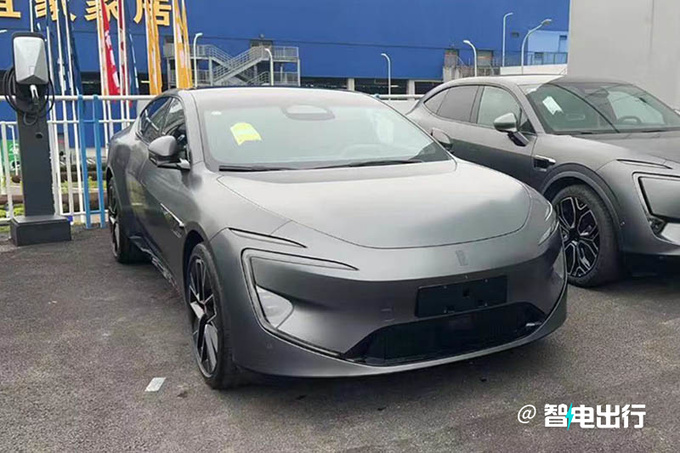
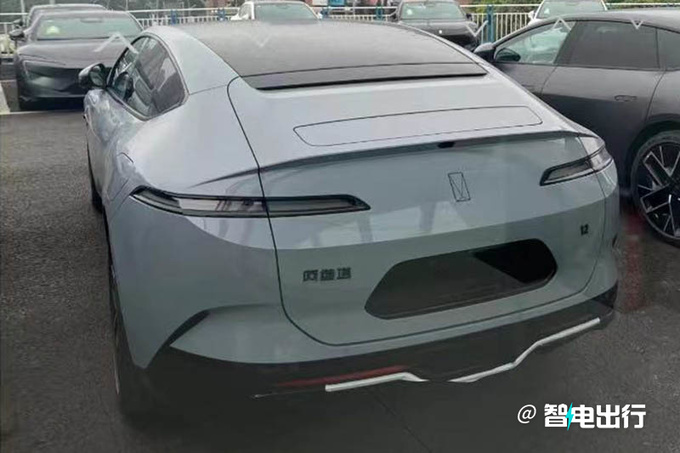
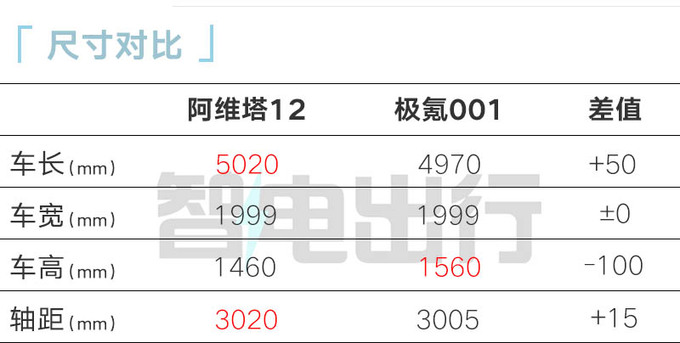
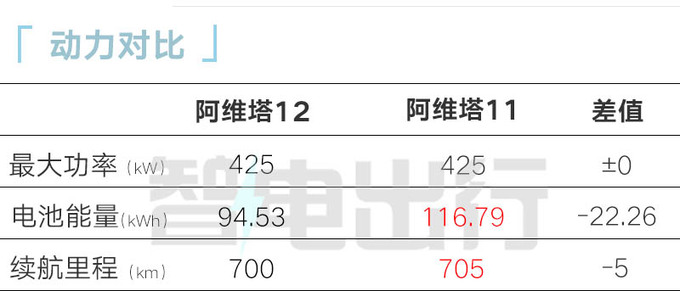
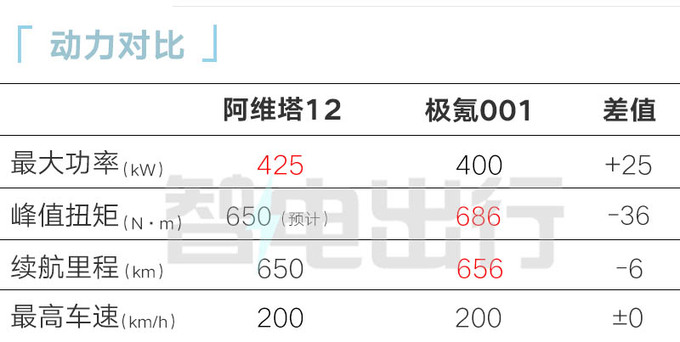
I learned from Zhidian Travel that I have arrived at the store. The new car is built on CHN platform, with a length of over 5 meters and a wheelbase of over 3 meters, which is larger than the 001 with similar positioning, and the rear shape is similar. 12 will provide two power versions of single-motor two-wheel drive and dual-motor four-wheel drive, with a maximum battery life of 700 kilometers.

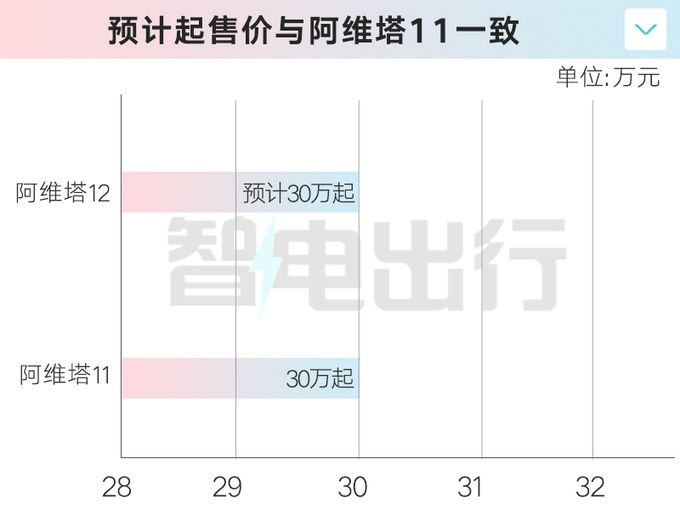
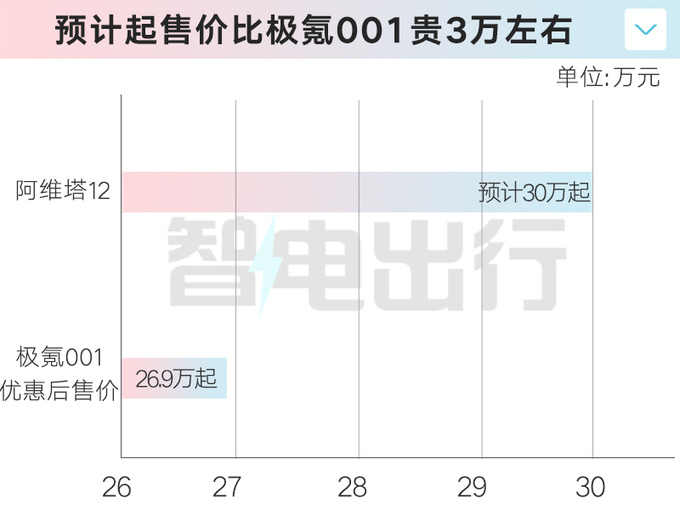
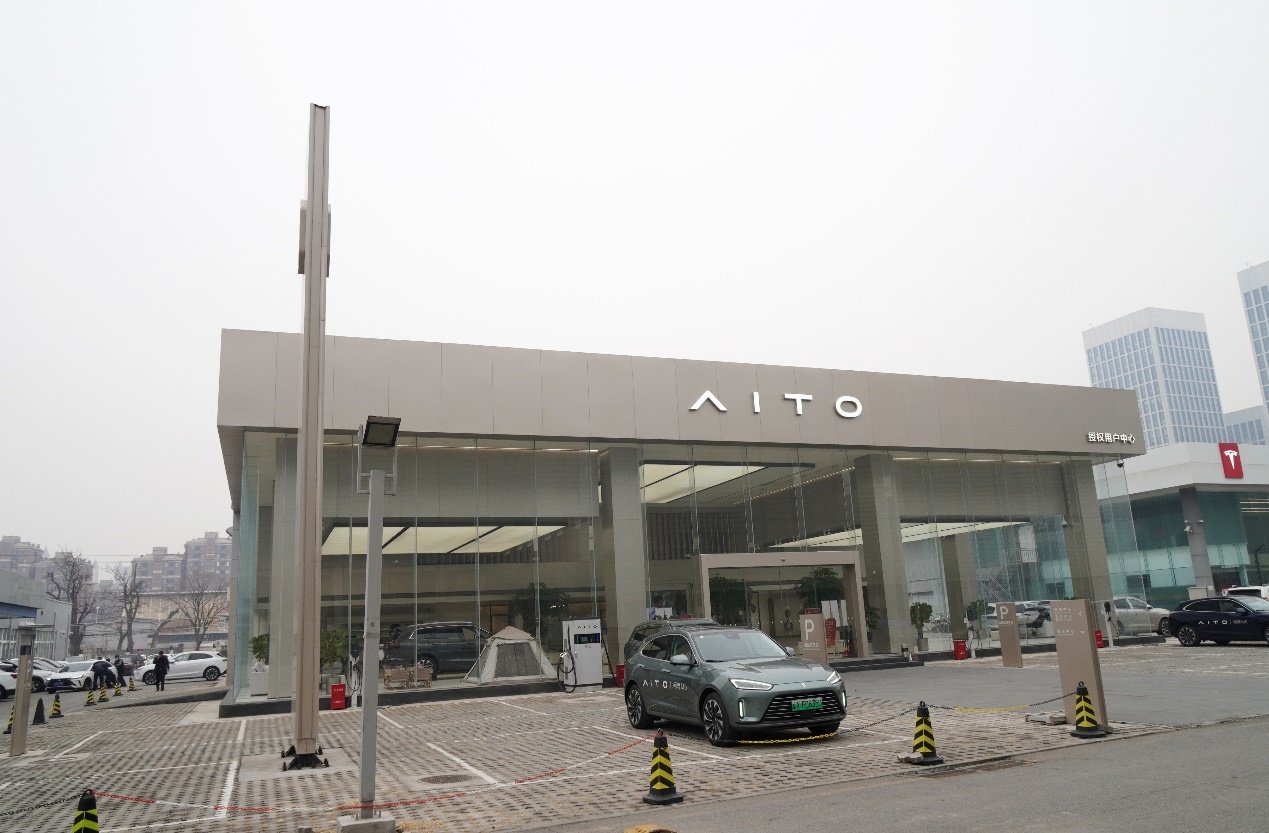
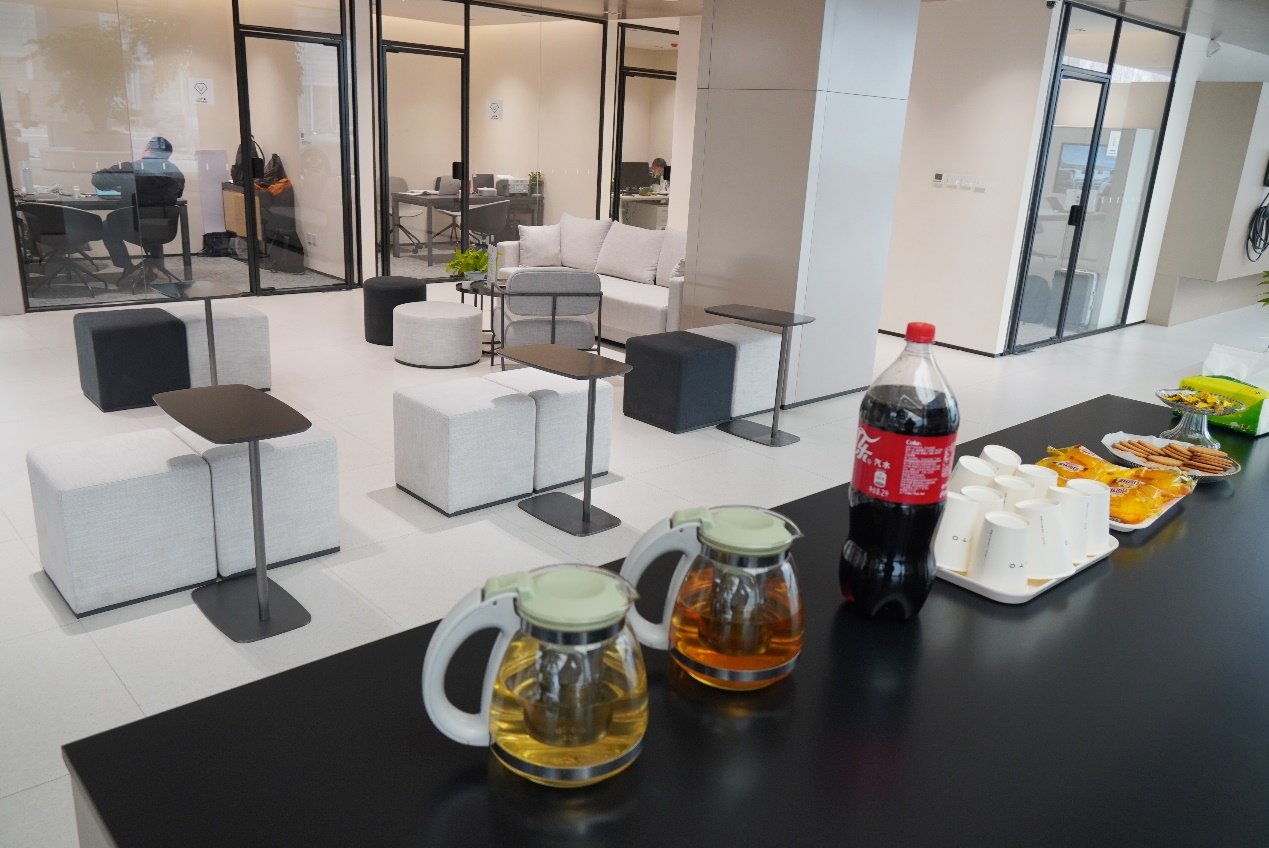
The staff of Aouita Experience Center said that Aouita 12 will start the test drive and make a small order on October 22, and will be officially listed on October 31, with an estimated starting price of around 300,000 yuan.

Aouita's 12-store salesman is expected to sell 300,000-400,000 yuan on the 31st-Figure 2.

Aouita's 12-store salesman is expected to sell 300,000-400,000 yuan on the 31st-Figure 3.

Aouita's 12-store salesman is expected to sell 300,000-400,000 yuan on the 31st-Figure 4.

Aouita's 12-month-to-store sales went on the market on October 31st or sold 300,000 units-Figure 1.

Aouita's 12-month-to-store sales went on the market on October 31st or sold 300,000 units-Figure 2.

Aouita's 12-store salesman is expected to sell 300,000-400,000 yuan on the 31st-Figure 7.

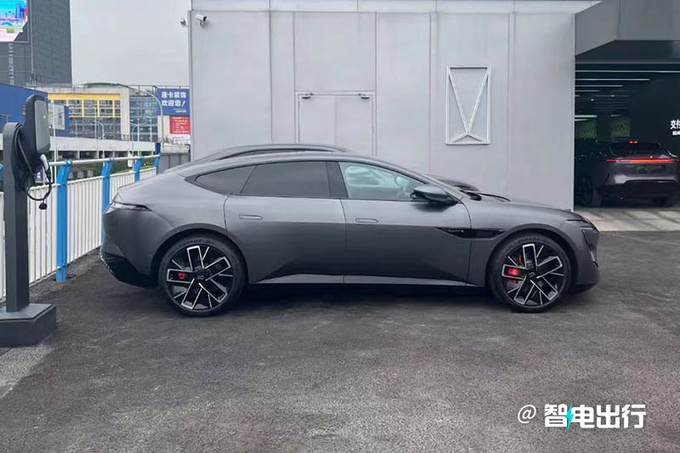
The C-shaped light strip of Aouita 12 is integrated with the decoration under the bumper. The center of the grille is a laser radar, and the front cover is equipped with a Halo screen. The side of the car adopts a hunting and running shape similar to Krypton 001, and the lateral laser radar is located on both sides of the front fender. It is also equipped with frameless doors and hidden door handles. The tail is similar to that of, equipped with a liftable tail. The new car will also introduce a sports kit, and the body will be decorated with front shovel, side skirt and tail diffuser.

Aouita's 12-store salesman is expected to sell 300,000-400,000 yuan on the 31st-Figure 8.

Aouita's 12-store salesman is expected to sell 300,000-400,000 yuan on the 31st-Figure 9.

Aouita's 12-store salesman is expected to sell 300,000-400,000 yuan on the 31st-Figure 10.

Aouita 12 arrived at the store and the salesperson went public on the 31st. It is estimated that the sales will be 300,000-400,000-Figure 11.

Aouita 12 arrived at the store and the salesperson went public on the 31st. It is estimated that the sales will be 300,000-400,000-Figure 12.

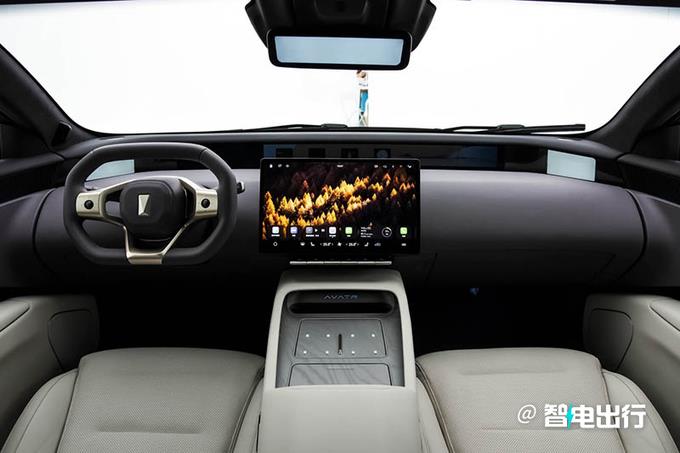
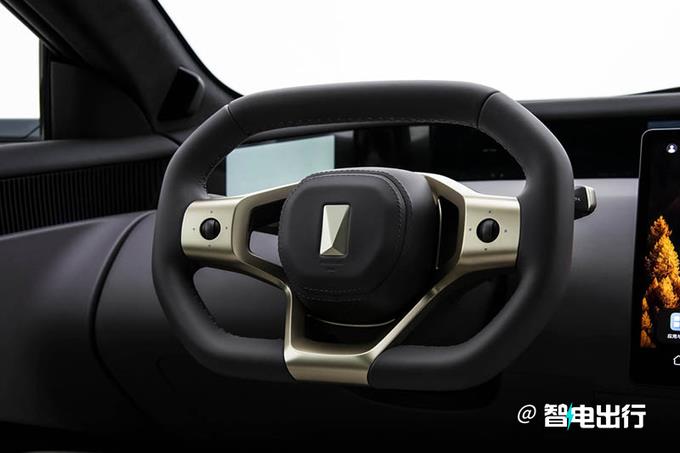
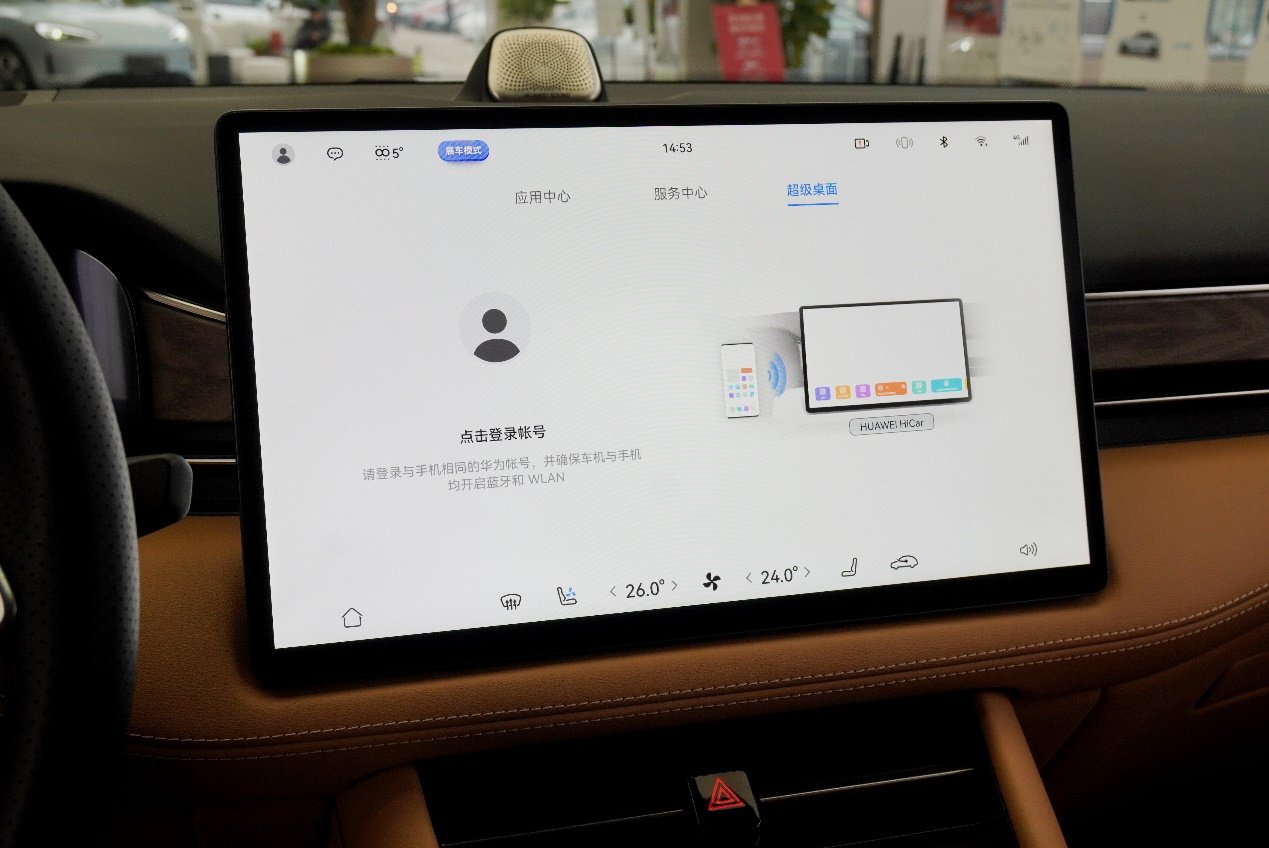
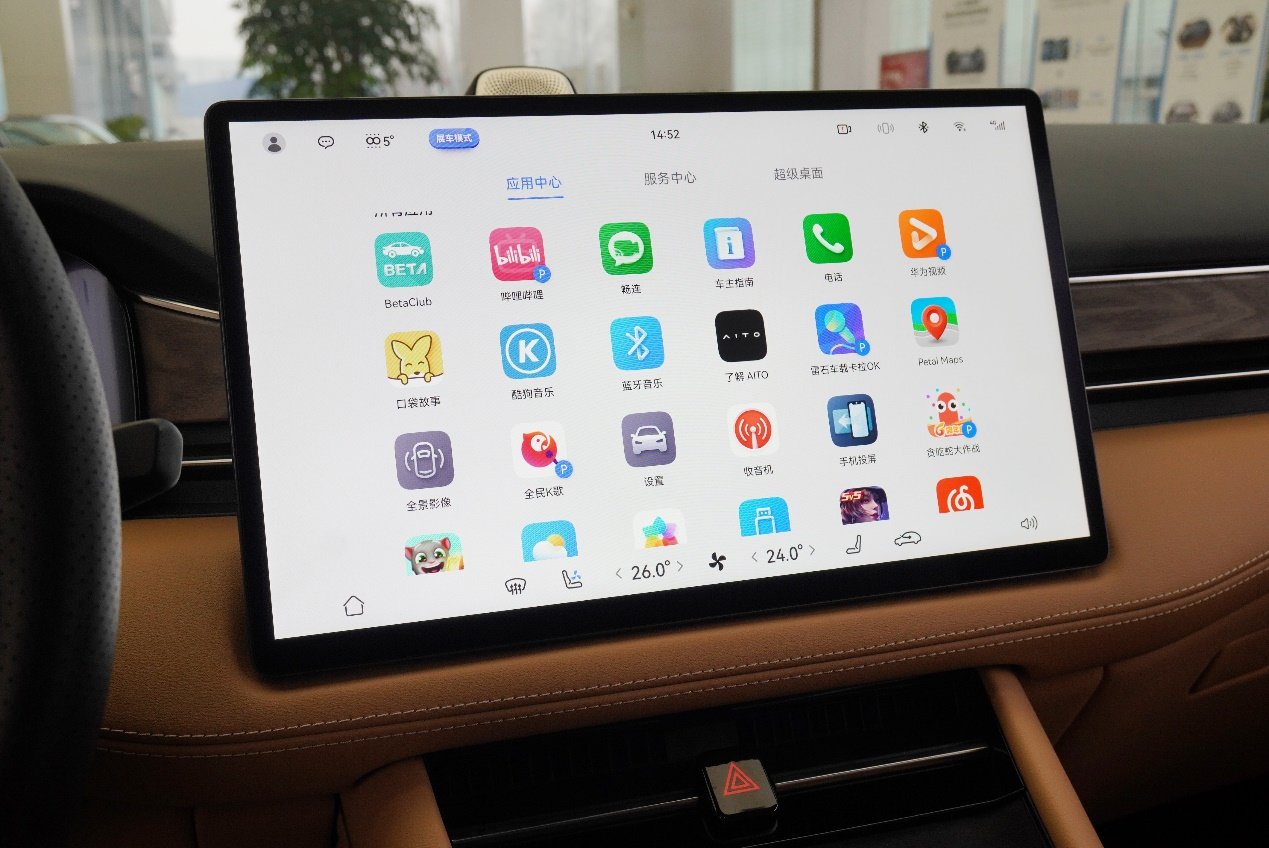
The car is equipped with a dual flat-bottomed multifunctional steering wheel, a large-size suspended central control panel and a 35.4-inch 4K panoramic embracing display screen. The car will be equipped with Huawei HarmonyOS 4.0 car system, while the wrapped auxiliary instrument panel is straighter than Aouita 11, and it is also designed with air conditioning air outlets, dual mobile phone wireless charging panels, dual cup holders, etc., and is also equipped with front double zero gravity seats.

Aouita's 12-store salesman is expected to sell 300,000-400,000 yuan on the 31st-Figure 13.

Aouita 12 arrived at the store and the salesperson went public on the 31st. It is estimated that the sales will be 300,000-400,000-Figure 14.

Aouita 12 is equipped with Huawei DriveONE motor system, and the maximum power of the front/rear motor of the dual-motor model is 195 kW/230 kW respectively; The maximum power of single motor model is 230kW. The whole system is equipped with Contemporary Amperex Technology Co., Limited ternary lithium battery with a total energy of 94.53kWh, and its battery life is 650km and 700km respectively.

Meituan comments on entering the 100 billion medical beauty market: saying it will strictly review qualifications and adopt a conservative strategy

Hyaluronic acid, botulinum toxin, water light needles, hair removal, skin management… Meituan Review (03690.HK) is entering the growing medical aesthetic market.

On January 22, at the Meituan Dianping Medical Beauty Industry Summit held in Shanghai, Li Xiaohui, head of Meituan Dianping Medical Beauty Medical Business Department, said in an interview with surging news reporters that there are many user pain points in the medical beauty industry, such as opaque information and opaque decision-making, so an Internet-based platform is needed to help users make better decisions and ensure the safety of medical beauty consumption. "Meituan Dianping is a word-of-mouth platform in everyone’s mind, and medical beauty itself needs users to comment on good and bad."

Meituan Dianping has been incubating the medical beauty business since August 2017. After more than a year of operation, the medical beauty business has become an independent business department from a sub-category under the original Beauty Business Department. It is reported that Meituan Medical Beauty Channel has achieved a 6-fold rapid growth in users and a 5-fold increase in the number of products in the past year. As of September 2018, it has covered 47 cities across the country and more than 1,600 cooperative merchants.

40% are young users under the age of 25, and 20% are male

Open the "Medical Beauty" channel of Meituan or Dianping App, and 400 medical beauty items are divided into 18 categories. Just one "facial filling" can find 10 small items such as rhinoplasty, forehead filling, chin padding, apple muscle filling, and aegyo saliva.

Here, you can quickly find the effect you want through the three dimensions of hospital, doctor or product. In some star brand beauty hospitals, there are already thousands of user experience reports as a reference. Many products provided by beauty hospitals have been simultaneously launched on the Meituan medical beauty platform. Consumers can pay in advance directly on the Meituan platform, and then pay the balance after arriving at the store.

Pull down the page, you can see a user diary, with pictures and texts recording the comparison photos before and after the experience. In addition, in the "Institute of Medical Aesthetics", you can see that nearly 30,000 users are sharing their medical beauty experiences.

The pictures in this article are all pictures of surging news reporter Yang Xinqian
According to the data revealed by the above summit, on the Meituan review platform, the trend of younger medical beauty consumers is obvious. Medical beauty consumers under the age of 35 account for more than 80%, of which under the age of 25 are the main users of medical beauty, accounting for 40%.

In terms of user data, women account for 80%, men account for 20%, and the unit price of male customers is not weaker than that of women. For anti-aging, botulinum toxin, hyaluronic acid and other products, users will buy multiple times.

Li Xiaohui said that the core of the Meituan platform is "eating, drinking and having fun", and the transaction attribute is high-frequency. At this stage, it is involved in the low-frequency business of medical beauty, which has the opportunity to deepen user value.

Industry data show that by 2020, the size of China’s medical beauty market will reach 460 billion yuan, and the growth rate will remain above 30%. However, the population penetration rate of the medical beauty market is only 2%, the market is still in the early stage, and the market is "mixed", fake drugs, parallel imports, unlicensed doctors, unlicensed clinics and other industry chaos still exists.

How can internet platforms ensure the safety of medical and aesthetic consumption?

Since medical beauty products are service attributes, not standard products, there are unsafe factors in several links such as drugs, institutions, and services. For Internet platforms, opportunities and challenges coexist.

Li Xiaohui told Surging News that Meituan currently focuses on "light medical beauty", and it is still a conservative strategy to "focus on medical beauty". The so-called "light medical beauty" refers to medical beauty projects that are relatively light in user decision-making, such as hyaluronic acid, botulinum toxin, water light needles, rather than breast augmentation. Li Xiaohui said that the order volume of "light medical beauty" currently accounts for more than 70% on the Meituan platform.

Relatively speaking, "light medical beauty" is also easier to achieve Internet-based. Li Xiaohui introduced that Meituan has special operation personnel to help institutions make products online, and at the same time track these diaries to maintain a certain update frequency. This is to form a closed loop for the entire transaction. Once there is a risk, the platform can also be traced back.

"Before Meituan did medical beauty, many users found it on the search platform, but in fact, users must hope to see on the platform whether this medical beauty institution has qualifications and licenses, whether its reputation is good, how users evaluate it, and whether it is safe." Li Xiaohui told The Paper.

At the investment promotion level, Li Xiaohui said that the platform will conduct strict qualification review. At present, the medical beauty institutions that have settled in Meituan Dianping are all certified, and the qualifications of doctors are open and transparent. There are several large-scale audit teams within the company.

Medical and aesthetic institutions settled in Meituan need "bright certificates"

Meituan announced at the meeting on the same day that the upstream medical and aesthetic drug brands and distribution agencies initiated the establishment of the "Genuine Alliance", which directly displays the authorization information of drug qualifications on the website, and opens the drug scan code verification function in the medical and aesthetic institutions to crack down on counterfeit and shoddy products. The first batch of partners include Ruilan, Huaxi Bio, Aierjian, etc. This can also solve the problem of opaque prices to a certain extent.

According to reports, Meituan Dianping also provides optional insurance services with an advance compensation mechanism.

AITO asks the world to explore the store experience

With the popularity of new energy vehicles in China, most consumers will try to consider buying a new energy vehicle to meet their daily needs when buying a car. In this era full of intelligence, the intelligence level and endurance performance of a new energy vehicle have become the most concerned issues for consumers. When it comes to the intelligence of new energy vehicles, we have to mention the Celestial brand with Huawei’s empowerment. Today, I will take you to see what are the highlights of AITO’s models.

AITO Wenjie brand was released in 2021. It is a brand-new high-end new energy vehicle brand owned by Celeste Automobile, and also a smart car brand with Huawei empowerment, focusing on the domestic high-end smart car market. Although it has only been less than two years since AITO’s brand was released, its products have occupied a place in the high-end market, and the delivery volume of the first extended-range model has also increased steadily since its release, and then the flagship model and the pure electric model of the M5 have been launched. On the occasion of the opening of the year in 2023, AITO Wenjie brand not only lowered the price of its products, but also brought users a series of measures such as store rejuvenation and worry-free service.

AITO user center is completely renewed.

Brand storefronts distributed in various cities are not only the owner’s second home, but also the face of the brand, which shows the tonality and strength of the brand to the outside world. Therefore, brands should also think carefully about the design and decoration of storefronts and show the best side to consumers. The upgraded AITO User Center is full of science and technology, using a minimalist and textured black and white gray+cocoa tea gold color scheme, which looks luxurious from the outside. The interior also uses a simple decoration style, and the overall color is light, which highlights a luxury style.

Based on brand-new service processes and standards, the newly upgraded AITO User Center has re-planned and divided the space to provide users with brand-new car buying experience and after-sales maintenance service. Provide user experience area, exhibition hall, boutique display, negotiation and audio service. The user’s lounge provides a spacious and comfortable sofa and a variety of snacks and drinks. You can also order a cup of coffee in the coffee area after watching the car and enjoy the warmth and comfort at home.

The new price of the two models in the New Year is lowered, and the old owners are not forgotten.

For buying a car, the price must be the place that consumers are most concerned about. The subsidy policy for new energy vehicles, which has been enjoyed for 13 years, has come to an "end" with the disappearance of the flavor of the year, which means that the days of bonus hunter are gone forever. In the face of the new policy, many car companies have officially announced price increases to cope with the cost pressure. At this time, the AITO brand played the role of a retrograde. Just as everyone announced the price increase, AITO did lower the official guide price of the M5 pure electricity and the M7 pure electricity, with the highest drop of 30,000 yuan for individual configuration models. In addition, for users who have already picked up the car, AITO also gave gifts such as basic maintenance, extended warranty and points.

As for the car owners who have bought cars, AITO has not forgotten you, and provided the first car owners with the rights package with a total value of 33,000 ~ 35,000, including an 8-year/160,000-kilometer extended vehicle warranty worth 21,000 ~ 23,000 yuan. And 120,000 AITO points worth 12,000 yuan can be used to purchase Huawei products in AITO Mall. At the same time, for the customer M5 whose price has not been adjusted, it also provides two years of basic maintenance, which obviously increases the trust and loyalty of users invisibly.

What are the highlights of AITO models?

I think many people will have this experience. Sometimes they will get to know a brand you are not familiar with because they choose a pleasant product. After a long-term contact, you will gradually understand it and become a loyal fan of this brand. I think AITO Jiejie brand also has this ability. It can gradually turn consumers into its loyal fans through its own products. Then let’s take a look at what highlights the models under AITO Jiejie brand have.

Like a car must start from the appearance. Although consumers are not necessarily Yan value parties, everyone has different requirements for beauty. AITO’s three models all adopt a simple design, and the smooth body curve highlights the beauty of the lines of the vehicle. The appearance of the extended range version of Wujie M5 is basically the same as that of the pure electric version. The pure electric version adopts a closed front grille, which is more like a new energy vehicle. The extended-range version looks relatively conventional, and the pop-up door handle is not only beautiful but also reduces the wind resistance. According to the official, the wind resistance coefficient of the two cars is only 0.266cd.

M5 Extended Range Edition

Wenjie M5 pure electric plate

As the flagship SUV model of the current brand, Wenjie M7 is positioned as a luxurious and intelligent large-scale electric SUV, with the ultimate aesthetic design that perfectly interprets the luxurious and comfortable space and the sense of science and technology. In terms of appearance design, it is in the same strain as Wenjie M5, which came out earlier, and the whole vehicle embodies elegant, dynamic and atmospheric modeling.

M7 Extended Range Edition

In terms of interior, the two versions of the M5 are basically the same, and the lightweight design and the atmosphere full of science and technology are very in line with the positioning of these two cars. It is worth mentioning that the mobile phone wireless charging panel on the auxiliary instrument panel has been upgraded to a dual-machine position, and the power has reached 40 watts. The interior color also has two new color schemes compared with the extended-range model, namely, Que Yu Hong and Shaohua Apricot, one of which highlights the warmth of home and the other highlights the sense of sports.

Wenjie M5 Extended Range Edition Interior

Wenjie M5 pure electric version mobile phone charging panel

In the design of the interior, the M7 maintains what a standard smart car should look like. The interior is all wrapped in soft materials, and a moderate combination of piano paint panel and wood decorative board creates a strong sense of luxury. No matter where you touch and press the cockpit, you can feel the excellent feel brought by excellent materials. It is not an exaggeration to say that it can rival a million-class luxury car.

Compared with the asking world M5, the asking world M7 is superior in riding comfort. Not only the seating space and seat setting are more advantageous, but also the "zero gravity seat" configuration is provided. The seat innovatively adopts the original 3-axis dynamic adjustment, and through the linkage adjustment of the double slide rails driven by 6 motors, the seat can move backward and left to achieve the ultimate space experience. Sitting on it feels like floating on the water or in the clouds.

The M7 also provides a professional-grade sound system with 19 units for HUAWEI SOUND, which uses Boom-Boom bass transient control technology and can perfectly support the output of 1000W power amplifier. Full-system active frequency division technology, 7.1-channel immersion sound field, industry-class main driver headrest sound system and ENC active noise reduction function bring a better immersive audio-visual experience.

As a leading brand of high-end smart models, AITO has a leading edge in the smart cockpit after being empowered by Huawei, and it is also an important point of view of the product. The intelligent cockpit system of Huawei HarmonyOS is installed in the car world M5, the car world M5 EV and the car world M7. This system can be seamlessly connected with Huawei mobile phones, and provides a "super desktop" function, which realizes the layout display of the car-machine interface parallel to the horizon and the integration and sharing of the mobile phone ecology and the car-machine ecology. It also supports the mutual calling function of the car-machine hardware and various interactive layout coverage. For example, when using WeChat to make video calls with family members, the system will call the camera in the car to realize.

In addition, Huawei HarmonyOS system also provides a wealth of online entertainment resources, ranging from music videos to smart homes. It can be said that as long as you drive a car with AITO brand, the mobile phone is basically useless, and entertainment navigation can be done on the car.

AITO Jiejie brand used the extended program power in its early product Jiejie M5 and mid-term product Jiejie M7. The pure battery life of Wenjie M5 can reach 200 kilometers, and the comprehensive battery life is 1100+ kilometers, while the pure battery life of Wenjie M7 equipped with 40kWh ternary lithium battery is better, reaching 230 kilometers and the comprehensive battery life is over 1200 kilometers. If it’s just a city ride and it’s convenient to charge, it can be used as a pure electric vehicle. Even if you travel long distances and have a battery life of more than 1000 kilometers, what are you worried about?

In order to meet consumers’ more diversified car demand and market demand, and to gain a foothold in the pure electric new energy vehicle market, AITO Jiejie launched the pure electric vehicle M5 EV at the end of 2022. The pure electric version has mainly changed in power, providing two versions of standard rear-drive and four-wheel drive. The rear-drive version uses a ternary lithium battery of 80kWh, and the rear-drive version has a battery life of 620 kilometers under CLCT standards. The four-wheel drive performance version is 552 kilometers. This endurance performance belongs to the upstream level of the echelon, and the four-wheel drive version can also bring excellent power and good handling performance to users.

The M5 EV version also provides a super power-saving mode, which can be turned on with one button when the battery is too low and the charging pile is far away. At this time, the vehicle will provide a comprehensive cruising range of 12 kilometers to help you reach the charging station closest to you, which gives the owner an extra car guarantee.

Quest M5, Quest M5 pure electric EV and Quest M7 all provide the mainstream intelligent driving assistance functions at present, and I have the honor to experience them deeply. After the intelligent driving assistance system is turned on, the logic and operation stability of the automatic driving assistance function of the system are good, and vehicles with lane change and traffic jam can be predicted in advance, and the lane can be kept in the center of the lane, without the situation of "drawing dragons" on the left and right.

It is worth mentioning that all models of AITO Jiejie brand currently support V2L external discharge function, which means that you can use them as a large outdoor power supply. If camping is hot recently, you can use the external discharge function to drive more powerful household appliances, so as not to be bound by energy and improve the comfort of camping.

Upgrading process standards and launching worry-free services

Just like the one mentioned at the beginning of the article, buying goods is actually buying services. Only by satisfying consumers can we improve brand image and user loyalty. The worry-free service launched by AITO Jiejie brand this time is based on the user center, including the vision and implementation standards of network capability and service capability.

In addition to the overall rejuvenation of brand stores, brand service outlets are gradually increasing. Up to now, AITO brand has covered more than 230 cities and more than 1,000 stores. The wide distribution of stores allows users to enjoy peace of mind and comfort wherever they go.

In addition to the widely distributed sales network in China, AITO has also upgraded its service processes and standards. From the moment users enter the store to the moment they leave, users can enjoy the worry-free and pleasant service experiences such as intimate reception, safe construction and sincere delivery, and create a one-stop functional site for consumers to see, buy, select, maintain and repair cars.

AITO is the fastest growing new energy brand in the world.

Again, without good products and good services, everything is empty talk. It’s not easy for this new brand AITO Wenjie, which was established less than two years ago, to stand out in today’s fiercely competitive domestic new energy market with the endorsement of Cyrus and the empowerment of Huawei, and it’s not easy to launch three products in just one year. Moreover, the cumulative delivery of Wenjie M5 has exceeded 10,000 in 87 days after its listing, thus setting the shortest record for the delivery of a single brand model to exceed 10,000, and its strength can’t be underestimated in the domestic new energy vehicle market.

In terms of brand services, a series of services, such as the rejuvenation of AITO’s brand stores and the improvement of service standards, provide consumers with exquisite car purchase and car use experience, but also invisibly enhance the brand value. Especially after the end of the subsidy policy for new energy vehicles, AITO brand not only lowered the price of new cars, but also left the pressure for itself to give back to users. At the same time, it also introduced various subsidy policies for old car owners, which also formed a sharp contrast with recent practices.

In short, there are excellent products and excellent services. I believe that AITO’s brand will definitely play its own role in the domestic new energy market and be recognized and loved by more consumers.

${newsItem.title}

During the day on the 10th, most parts of Chongqing were cloudy with intermittent light rain in the north, with a temperature of 5 ~ 16℃.  

According to the forecast of Chongqing Meteorological Observatory, from the night of the 10th to the day of the 12th, Chongqing will be mainly cloudy to sunny, and the Pingba Valley will be foggy on the morning of the 11th. From the night of the 12th to the day of the 13th, it turned to rain, with moderate rain in the south.

Weather forecast for the next three days

From the night of the 10th to the day of the 11th, it is cloudy to sunny, and the Pingba Valley area is foggy in the morning with a temperature of 3 ~ 22℃. The downtown area is cloudy to sunny with a temperature of 11 ~ 21℃.

From the night of the 11th to the day of the 12th, the area west of the west turned cloudy to cloudy with sporadic light rain, while the rest areas were cloudy and sunny, with a temperature of 4 ~ 23℃. The central city is cloudy and sunny, with a temperature of 11 ~ 22℃.

From the night of the 12th to the day of the 13th, there was moderate rain in the south and light rain in other areas, and the temperature was 7 ~ 18℃. There is light rain in the central city, and the temperature is 13 ~ 17℃.

Upstream journalist He Yan

Editor: Xia Hongling Editor: Lin Qi, Zhou Shangdou Audit: Feng Fei

Wonderful game is fun in the "ball"

  Zhang Heqing Our reporter Wu Jing Dai Yuewen/map

  From December 2 nd to December 16 th, the 6th CBSA Chinese Billiards World Championships started passionately in Yushan County. 496 players from 41 countries and regions around the world gathered in Yushan and staged a wonderful and fierce peak matchup.

  The total prize money of this competition reached 10.43 million yuan, including 3 million for the men’s team and 1 million for the women’s team. Numerous award-winning places and generous competition bonuses have attracted the world’s top billiards players to compete, which is not only a wonderful guarantee for the competition, but also a strong impetus for the sustainable development of Chinese billiards.

  "My goal in this competition is to enter the quarter-finals. Although it is very difficult, I will go all out!" Russian player Lutzke began to learn American billiards at the age of ten, but now he has a strong interest in Chinese billiards. He has participated in the Chinese billiards World Championships for three consecutive years. "I like Chinese billiards and prefer Yushan, a small and beautiful city."

  As a billiards project with independent intellectual property rights in China, Chinese billiards became popular in China as soon as it came out in the 1980s, and became a widespread sport in China. In 2015, China Billiards Association initiated the CBSA Chinese Billiards World Championship and held it for five consecutive times in Yushan. This billiards game invented by China people has been gradually accepted by billiards players and fans all over the world. The rules and skills of Chinese billiards have been spread around the world, and more and more countries and regions have begun to incorporate it into their own billiards system. Chinese billiards has become an important part of the world billiards game.

  In recent years, Yushan has made every effort to build a county-level sports brand featuring billiards, successfully hosted the 5th Chinese Billiards World Championships, the 4th Chinese Billiards World Open and the Chinese Billiards International Professional League, implemented three major industrial projects, namely "International Billiards Cultural City, Star Billiards Industrial Park and Top Billiards Tournament", and gradually stepped out of the road of high-quality development of county-level sports, from resources to products, from products to events, from events to culture and from culture to brands.