In recent years, all localities have introduced new policies for talent development-talent introduction, and we should make good use of it when retaining it.

Xu Junzuo (Xinhua News Agency)

People from other provinces handle the talent settlement business in the Population and Entry-Exit Management Service Center of Meilan Branch of Haikou Public Security Bureau, Hainan Province. Xinhua News Agency reporter Guo Chengshe
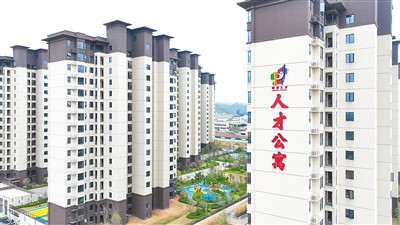
Located in zhanggong district, Ganzhou City, Jiangxi Province, Ganzhou Talent Apartment Community has complete supporting facilities, such as greening and sports facilities, to realize the occupancy of talents with bags. Photo by Hu Jiangtao (People’s Vision)

In Huai ‘an City, Jiangsu Province, the tram with the theme of "Huai ‘an Talent" shuttled through the bustling urban area to publicize the local talent policy. Photo by PG One (People’s Vision)
"What is the most expensive in the 21st century? Talent! "
Just after the Spring Festival holiday, Shanghai Pudong New Area issued a series of new policies on talent development, and put forward the goal of "the total amount of talent resources will grow to about 2 million in 2025". Not long ago, the local two conferences held intensively also made arrangements for doing a good job in talent work this year. At the beginning of the new year, all localities have released strong signals of thirst for talents.
Talent is the first resource. In recent years, all localities have studied the local "talent experience" well, and all kinds of talents have shown their abilities to promote the high-quality development of regional economy and society. In the practice of talent introduction, more and more city managers realize that talent introduction is the first and retention is the foundation. We should take multiple measures to optimize the ecology of talent development and stimulate the vitality of talent development.
Various localities have successively introduced "recruiting talents and practical tricks"
When it comes to pesticide residues, the staff of Lanzhou Food and Drug Inspection and Testing Institute in Gansu Province were impressed: in the past, it took half a month to test pesticide residues in a vegetable variety due to lack of means. Nowadays, with the Qualcomm-based non-targeted pesticide residue detection technology, the detection time has been shortened to one day, and the number of pesticide residues that can be detected has increased from dozens to thousands.
The change stems from the flexible talent introduction mechanism implemented in Lanzhou. In August 2019, Pang Guofang, academician of China Academy of Engineering and chief scientist of China Academy of Inspection and Quarantine, decided to set up an academician expert workstation in Lanzhou. The new technology for rapid detection of pesticide residues is Pang Guofang’s technical patent.
How to operate the "flexible talent introduction" in Lanzhou? Under the premise of not changing the relationship with the original unit, support employers to attract all kinds of talents at home and abroad to gather in local key fields and industries through consulting guidance, short-term part-time, project cooperation and migratory bird service. For the introduction of talents, the local government gives work subsidies, travel expenses, housing rental fees and other preferential benefits for reimbursement.
Since the academician expert workstation was unveiled, the local food testing level has been greatly improved. Relying on the workstation, Lanzhou Food and Drug Inspection and Testing Institute was also successfully approved as the first key laboratory at the ministerial level.
In Guiyang, Guizhou Province, Jiang Daoshun, general manager of Anxin CNC Technology Co., Ltd., led the team in the production workshop to develop the intelligent CNC shovel grinder. "I hope to break through the blockade of foreign technology and improve the situation that high-end CNC tool grinders rely almost entirely on imports." Jiang Daoshun said.
In recent years, Guiyang has implemented the introduction project of big data talents training to boost the development of big data industry. In the mind of Jiang Daoshun, the winner of the "Big Data Hundred Talents Program", "Intelligent Manufacturing" must rely on independent innovation. At present, the R&D and manufacturing team members of the company have more than 10 years of experience in developing CNC machine tools and CNC tools, and have more than 10 patents. Jiang Daoshun is full of confidence in realizing independent innovation.
Not only in the laboratory and production room, but also in the fields. "Foreign entrepreneurs, college students, veterans, migrant workers, etc. return to their hometowns to innovate and start businesses, and give full support in capital, technology and venues!" Wen Liang, who was born in Gaoshi Township, Yongxin County, Jiangxi Province, was moved.
After introducing Jinggang honey pomelo to Wen Lianglai, the investment promotion delegation from Gaoshi Township resolutely gave up a small factory opened in Shenzhen, returned to his hometown to set up a company and planted more than 80,000 honey pomelo seedlings. "Jinggang honey pomelo is a famous specialty, and there are preferential policies in the local area. I always want to go back to my hometown to start a business." For Wen Liang.
With the help of the local government, Wenlianglai’s business has become more and more prosperous. The output value of the orchard has reached more than 14 million yuan in the past two years, which has also driven the surrounding villagers to increase their income and become rich.
In recent years, "recruiting talents" has been introduced one after another in various places, and the door to attracting talents has been opened wider, and all kinds of talents have blossomed. According to statistics, the total number of human resources in China has reached 220 million, and the contribution rate of talents to economic and social development has been greatly improved, and the advantages of talents have been more and better transformed into advantages of innovation and development.
Optimize the soft environment and enhance competitiveness
Planted buttonwood, attracted the phoenix. To attract talents, we must first understand what talents value.
Liang Ma, a professor at the School of Public Administration of Renmin University of China, believes that "living and working in peace and contentment" is an important factor for talents to consider, including both career and life: having space and opportunities for development and an environment suitable for innovation and entrepreneurship, not "heroes are useless"; With high-quality commercial and public services, it can meet the needs of leisure, socialization, housing, education, medical care, and old-age care.
Throughout the previous initiatives to attract talents in various places, most of them were preferential policies such as loose settlement, subsidies and convenience. Liang Ma said that these policies are highly similar, causing some areas to fall into a large-scale homogenization competition, and the final effect is not obvious.
Some experts have also pointed out some problems in the practice of talent introduction. For example, some localities and units struggle to wear the "talent hat", but after the introduction of talents, they fail to make effective use of it; Some places blindly "give preferential treatment" to foreign talents and "neglect" local talents.
Taking stock of the policies of recruiting talents introduced by various places in recent years, more and more cities have made strategic adjustments. In addition to continuing to exert efforts on "real money and silver" such as housing and salary subsidies, we will pay more attention to making a fuss about institutional mechanisms, service guarantees and cultural atmosphere, and work hard to retain and make good use of talents.
"Talent gathering complements industrial development and urban development." Zhou Maohua, a macro researcher in the financial market department of China Everbright Bank, said that when attracting and retaining talents, all localities must try their best to optimize the soft environment and enhance their competitiveness.
Biomedicine is an important industry in Suzhou, Jiangsu Province, but the evaluation of professional titles of talents in biomedical industry can only refer to chemical talents. Xiao Sheng, who came to Suzhou to start a business in 2015, has three licenses of clinician, clinical cytogenetics and clinical molecular genetics and more than 30 years of medical experience, but the problem of his professional title has not been solved.
In order to break through the bottleneck in the evaluation of biomedical professionals, in 2021, Suzhou began the evaluation of biomedical engineering titles with Suzhou Free Trade Zone as a pilot, and Xiao Sheng was successfully awarded the deputy senior title. In addition, Suzhou has also actively decentralized private enterprises, and pilot leading enterprises have undertaken independent evaluation of professional titles, so that market participants have the right to speak on talent evaluation.
Not only to decentralize the main body of the employer, but also to loosen the talents. Recently, Chongqing Science and Technology Bureau and other three departments issued a notice to reduce the burden on young scientific and technological talents. Among them, it is clear that a due diligence exemption mechanism should be established for scientific research projects in frontier fields with strong exploration and high research and development risks; Clean up the unreasonable system, improve the internal evaluation mechanism, and ensure that young full-time researchers spend no less than 4/5 of their working days on scientific research.
In order to provide high-quality and convenient services for talents’ innovation, entrepreneurship and work life, xiong’an new area has launched the "Hero Card". Cardholders can enjoy a variety of benefits, such as ensuring the establishment, serving as a reference for evaluating professional titles, giving priority to applying for admission to talent apartments, buying commercial houses or shared property houses in the new district, bringing their families to settle down, etc., and they can also enjoy 14 convenient services such as financing support, recreation and sports, medical care and health care, and children’s enrollment. Liang Ma said that only by doing a good job in the "life cycle" service of talents and helping them to eliminate their worries can we better stimulate the vitality of talents.
Enhance the sense of identity and belonging of talents
Not long ago, the Institute of Sociology of China Academy of Social Sciences and Social Science Literature Publishing House published the Blue Book of Society: Analysis and Prediction of Social Situation in China in 2023. The data shows that in 2021, 34.1% of college students want to work in Beishangguang, and 39.27% want to go to second-tier capital cities or non-capital cities with more developed economy, totaling more than 70%. However, this proportion shows a slow downward trend. Correspondingly, the proportion of college students who want to work in small and medium-sized cities, small counties, grassroots towns and rural areas in the third and fourth lines has increased.
"The values, employment views and life views of the new generation of young people are undergoing significant changes. They pay more attention to the balance between life and work and pursue a high-quality life." Liang Ma believes that the increase in the number of college graduates who choose to work in third-and fourth-tier cities can not only broaden their employment choices, but also transport talents to these areas, which is a phenomenon worthy of recognition.
The phenomenon that some college graduates go to third-and fourth-tier cities for employment appeared many years ago, and many young people no longer regard staying in first-and second-tier cities as the only option. Insiders pointed out that in reality, the establishment is an important factor to attract young people to third-and fourth-tier cities. Even so, there will still be different degrees of "backflow", mainly because, outside the establishment, some places can not meet the environmental needs of university graduates for talent competition and training.
How to promote the formation of a virtuous circle of attracting, using and developing talents in third-and fourth-tier cities?
It is a good way to develop characteristic industries. Longyan City, Fujian Province has further enhanced its talent attraction by building strategic emerging industries such as non-ferrous metal industry, machinery and equipment industry, new materials, new energy and electronic information. "There are more and more well-known enterprises, the scale of the industry is getting bigger and bigger, and the wages are getting higher and higher." Hua Xiangbin, chairman of Fujian Deer Technology Co., Ltd., located in the city, said that there were not many undergraduates in the industrial park where the company was located, and now many of them are master’s and doctoral graduates from famous universities such as Xiamen University.
Ella Guo, director of the Comprehensive Research Office of the Institute of Economic System and Management, China Macroeconomic Research Institute, proposed that the attraction to local talents should be enhanced, on the one hand, to attract local talents to return home, and on the other hand, to increase efforts to keep local college graduates in local employment.
The reporter found that many places have targeted local talents: some places have proposed to establish a "whole process" tracking mechanism for local talents, and guide them according to their majors, interests, employment destinations, etc., to ensure accurate introduction of talents to return home; In some places, the standards of "education, thesis, age and identity" have been broken, and the evaluation and incentive mechanism has been improved. Local talents have become "hot cakes", and talents returning to their hometowns have more entrepreneurial confidence … …
"Between cities and talents is ‘ Go in both directions ’ . Cities attract and achieve talents, and talents choose and contribute to cities. " Liang Ma said that third-and fourth-tier cities should develop in a dislocation with first-and second-tier cities, and recruit talents based on their own characteristics and location advantages.
"The characteristics of a place are very important, and some small and medium-sized cities still have not found their most distinctive or touching places." Liang Ma said that it is necessary to strengthen the emotional bond between talents and the city, build a livable city, and enhance talents’ sense of identity and belonging to the city.